Thirty minutes is the realistic median practice window for adult beginners. Not the aspirational sixty, not the deflated ten on the bad days. Thirty is what fits between coming home, eating, and starting the rest of the evening. The shape of that thirty minutes is what decides whether you progress in six months or stand in roughly the same place.
Most online routines for adult beginners do not survive contact with a real Wednesday. They prescribe twenty minutes of Hanon for someone who has been playing for three weeks, or assume access to a teacher who can correct every wrong move. This article gives a different version — a concrete, block-by-block 30-minute routine that an adult beginner can actually do alone, that fits inside a working life, and that builds the right skills in the right order.
Why the standard 30-minute routine fails
The default beginner routine — fifteen minutes of scales, fifteen minutes of "your piece" — is a relic from a teaching tradition that assumed children practicing daily under supervision. It does two things badly. First, it asks beginners to spend half their session on technique their hands cannot yet make use of. A beginner playing a C major scale repeatedly is mostly rehearsing tense fingers, not building dexterity. Second, it leaves no room for sight-reading, listening, or review — the components that quietly determine whether you can still play this piece three months from now.
The honest framing is that thirty minutes is enough for an adult beginner only if it is structured. An unstructured thirty minutes typically becomes: ten minutes warming up, twelve minutes running through the current piece front-to-back two or three times, and eight minutes of distracted noodling. That is not practice. It is hovering over the piano with a metronome on.
"An unstructured thirty minutes is not practice. It is hovering over the piano with a metronome on."
The routine, block by block
The plan below splits the thirty minutes into five blocks. The blocks are short on purpose. Beginner attention is a real constraint, and the worst sessions are the ones where one component eats the entire window. The Pract.is article on practising efficiently in 20 minutes works as a tighter sibling to this one when even thirty is not available.
The 30-minute structure
Block 1 — Warm-up & orientation
One scale, hands separate, slow with a metronome around 60 BPM. Pay attention to relaxed shoulders and a quiet thumb. The goal is not the scale — it is arriving at the keyboard.
Block 2 — Current piece, isolation work
The largest block. Pick the two hardest bars and loop them, hands separate, very slow, then hands together. Add one bar before and one bar after, so the section can connect. No full run-throughs in this block.
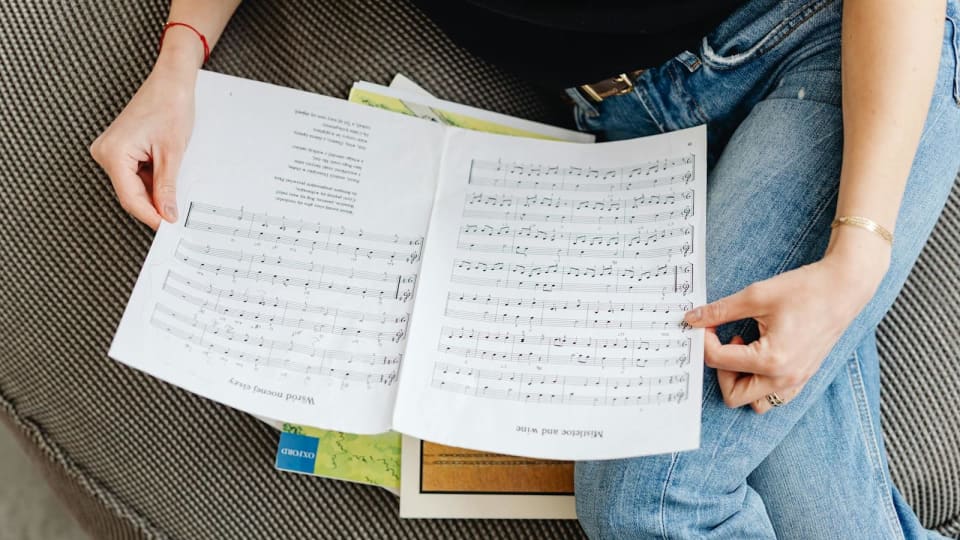
Block 3 — Easy piece or sight-reading
One piece below your current level, played all the way through — or a fresh page from a graded sight-reading collection. This block protects musicality and confidence while the main piece is still under construction.
Block 4 — Current piece, run-through
Now you connect. Play the current piece — or the section you can manage — straight through, at a tempo where you can stay accurate. One or two takes, no more. This is also when to record yourself on your phone.
Block 5 — Review & next-day note
Write a single sentence: what improved today, and what should the first ten minutes of tomorrow's session look like. This is the most underrated block in beginner practice and the one most often skipped.
Why these block sizes, in this order
The warm-up is short because most adult beginners do not need a long mechanical preparation — they need a moment of attention. Five minutes is enough to settle the body and the eye. Hanon-style warm-ups and long scale rotations belong in routines for late beginners and intermediates, not here. The earlier guide on warming up without wasting 20 minutes covers the trap of letting warm-up eat the session.
The fifteen-minute repertoire block is the engine of the routine. The structure inside it matters as much as the time. Isolation practice — looping the hardest bars rather than running the piece front to back — is the single most important habit a beginner can build. Repeated full run-throughs feel productive but mostly reinforce mistakes. The argument is laid out in detail in why isolation practice works better than running the whole piece. The principle scales all the way up to advanced playing; you may as well learn it now.
The five-minute "easy piece or sight-reading" block is the one most beginners skip and the one that quietly separates progressing students from stuck ones. Reading new music daily — even at a level just below your current piece — builds the eye-hand fluency that lets you learn the next piece faster. An easy piece played end-to-end keeps musicality alive while the harder piece is still mid-repair. Either is fine. Alternating across the week is better.
The three-minute run-through gives the current piece its single end-to-end pass. This is also the recording moment. A phone propped against a book, one or two takes, then back into the routine. Listening to a one-minute recording the next day will tell you more about what to fix than another ten minutes of practice. The Pract.is post on recording yourself practising and why you should covers the why; the routine here gives the when.
The two-minute review block at the end is the planning layer that turns isolated sessions into a learning curve. Without it, the next day's practice is whatever you happen to feel like, which converges, over weeks, on the easiest things in your folder.
A typical week using this routine
Doing the same thirty minutes seven days a week is the recipe for boredom and quiet drop-off. A better model is to keep the block structure but rotate the focus across the week. Three session types covers most of what a beginner needs.
| Day type | Focus shift | What changes inside the blocks |
|---|---|---|
| Deep work day (×3 / week) | Heavy repertoire block | The 15-minute block is fully isolation; the 5-minute block is sight-reading; the run-through is mandatory. |
| Lighter day (×3 / week) | More easy-piece time | Shorter isolation. The 5-minute block becomes the easy-piece block. The run-through becomes two takes for recording comparison. |
| Low-energy day (×1 / week) | Continuity over output | Slow reading, no isolation work, listen to a recording of the current piece by a real pianist. The point is keeping the streak alive. |
The third archetype matters more than it sounds. The Pract.is article on what to do in practice when you're too tired to do deep work argues that low-energy practice protects consistency in the only way that actually works long term. Skipping a tired Wednesday entirely is usually worse than spending fifteen of those thirty minutes on a quiet, easy session.
Photo: cottonbro studio via Pexels
What the routine assumes — and what to skip
A few practical assumptions are worth making explicit. The routine assumes an acoustic or weighted-key digital piano; tabletop unweighted keyboards work, but they distort the technique side. It assumes you have one current piece you are actively learning, at a level appropriate to your stage — Faber's adult method books, Alfred's adult course, or whatever your teacher is using, with a piece that takes weeks to learn rather than a single session. And it assumes a metronome — phone app or hardware, no preference.
It also deliberately leaves some things out. Long technique drills do not appear because a beginner's hands are not yet ready to make use of them productively. Music theory worksheets do not appear because at this stage theory is best absorbed through the pieces themselves and through a few minutes of weekly outside reading. Ear training drills do not appear for the same reason. The five-component framework in what to practice on piano every day covers when those components start mattering, and at what proportions for higher levels.
"The goal of an adult-beginner routine is to leave the bench, every day, with something measurably better than when you sat down."
The mistakes that quietly waste 30-minute sessions
Several specific failure patterns recur across the adult beginners I have seen in lessons and tracked in our usage data. The first is running the current piece end-to-end every day from the beginning, which mostly reinforces the mistakes baked into the first few attempts. The second is treating the session like a performance — getting frustrated with errors mid-flow rather than stopping and looping. The third is skipping the review block because it feels small; the next day's session then starts cold.
The fourth, less obvious one is letting the warm-up stretch. Five minutes is enough. Ten minutes of scales is not warm-up; it is procrastination dressed as discipline. The Pract.is essay on why "just play it more" is bad practice advice covers the broader version of this trap. Adult learners with limited time should be especially suspicious of any session block that consistently exceeds its allotment without obvious cause.
How to track this without making it a second job
The cleanest way to keep a routine like this alive is a one-line journal at the end of each session — the Block 5 note. What improved, what failed, what to start with tomorrow. A paper notebook works. A notes app works. A practice tracker like Pract.is works and adds visibility across weeks, which becomes useful around month three when patterns start showing up that you would otherwise miss; the underlying habit, not the tool, is what counts. The earlier post on using a practice log without turning it into homework covers what to track and what to ignore.
The honest test of any beginner routine is not whether it feels productive on day one. It is whether it survives a tired Wednesday in month three. The thirty minutes you actually do, six days a week, beat the perfect ninety-minute session you plan and skip. Keep the blocks small enough that the structure stays intact even when energy is low, and the routine will still be there in a year — which is when adult learners stop being beginners.