
45-Minute Piano Practice Routine for Intermediate Players
A concrete 45-minute practice plan for intermediate pianists juggling multiple pieces, real technique work, sight-reading, and the maintenance load that comes with a growing repertoire.
Pract.is Editorial
Research-based practice guidance for musicians from the Pract.is editorial team.

It is a Sunday evening in your second year of piano. You sit down with a sonatina you learned three months ago and discover that the trio section has quietly forgotten itself. The Burgmüller you started last week is full of fingering questions. You have not sight-read anything new in two weeks. The clock says you have forty-five minutes, and you are not entirely sure where they should go.
That moment is the intermediate plateau, and it is the reason most thirty-minute beginner routines stop fitting. Intermediate practice is no longer about getting one piece into your hands. It is about managing several pieces at different stages, scaling up real technique work, and building the supporting skills — reading, listening, musicianship — that decide whether your next year produces visible progress or just more minutes at the bench. The companion post on the 30-minute routine for adult beginners covers the simpler version; this one is the next step.
What actually changes at the intermediate stage
The shift from beginner to intermediate is rarely marked by a clean event. Most adult learners get there somewhere between year two and year four, depending on how seriously they have practised. The signals are familiar: you can play several pieces front to back, you start hearing differences in recordings of the same piece by different pianists, you no longer rely on the teacher to fingering every passage. What also changes — and this is the underrated part — is the practice problem itself.
The beginner problem is mostly "can I get this piece into my hands at all?" The intermediate problem is "can I get this piece into my hands without losing the three pieces I already have?" Add the fact that intermediate repertoire is meaningfully longer and harder, and the maintenance load alone starts eating any unstructured practice time. The piece on what to expect in year two of learning an instrument covers this transition in more detail.
"Intermediate practice is no longer about getting one piece into your hands. It is about not losing the three pieces you already have."
The 45-minute routine, broken into six blocks
The plan below splits forty-five minutes across six blocks. The block sizes are deliberately uneven. The longest block is repertoire — it has to be — and the shortest is the review note at the end. Each block has a single job, and each is short enough that boredom does not become a structural problem. The Pract.is guide on what to practice on piano every day covers the same five components at every level; this routine is what those proportions look like in practice for an intermediate player.
Time allocation across the 45 minutes
Block 1 — Technique, 8 minutes
Open with one scale set in the day's key — major and its relative minor, two octaves hands together at a moderate tempo, then the arpeggio for the same chord. The cycle should move across the week so that you visit all twenty-four keys roughly every two to three weeks; pick a system and stick to it. Add one piece-specific drill in the remaining minutes — a fast left-hand pattern from the current Beethoven, a trill from the Bach, a voicing exercise for the Schubert. Technique that is genuinely connected to the piece you are working on is several times more efficient than generic Hanon for the same eight minutes.
At this level, what matters in technique is not how fast you play it. It is whether the hand position, the wrist motion, and the relaxation pattern survive at the target tempo. Intermediate practice is also where targeted strength imbalances start mattering — the fourth finger that does not lift cleanly, the thumb that crashes on the downbeat. The Pract.is essay on why difficult passages fall apart at full speed goes deeper on the underlying mechanics.
Block 2 — Current and polishing repertoire, 18 minutes
This is the engine block. The eighteen minutes split across two pieces by default: roughly twelve minutes on the piece in active learning, six on the piece in polishing. On days when one piece needs disproportionate attention, the split can flex — but never to zero. A piece touched zero days a week is a piece quietly leaving your repertoire.
Inside the block, the rule that does most of the work is the same one that mattered at beginner level: isolation practice, not run-throughs. The two or three hardest bars get the bulk of the time, looped slowly and then at gradually increasing tempos, hands separate when needed, then hands together. The Pract.is post on why isolation practice works better than running the whole piece covers this in detail; the principle is more important at the intermediate level than at any other, because the pieces are now long enough that run-throughs feel productive while accomplishing very little.
Recording yourself once or twice a week during this block is the closest substitute for a teacher's ear. A two-minute recording of the problem section reveals more than another ten minutes of practice. The earlier post on recording yourself practicing piano and why you should explains why.
Block 3 — Sight-reading, 8 minutes
Sight-reading is the component that quietly separates intermediates who keep progressing from intermediates who stall. The brain skill you are building is pattern recognition — chords, intervals, rhythmic groups — and it only develops with daily contact. Eight minutes is enough if it is genuinely daily. The material should be unfamiliar and slightly easier than your current repertoire level; a graded sight-reading collection or a fresh easier piece works equally well.
The internal rule for this block: keep going. Eyes ahead, no stopping to fix wrong notes, prioritise rhythmic continuity over pitch accuracy. The point is not to play the page perfectly. It is to read the page, end to end, at a steady pulse. Stopping to correct errors trains exactly the wrong reflex.
Block 4 — Maintenance piece, 6 minutes
This is the block that did not exist at beginner level. By intermediate, you carry pieces that you "know" but that decay if untouched. Six minutes per session, rotated across the week, lets you keep three to five maintenance pieces alive. The work inside the block is not a full performance run. It is a partial — usually the openings, the worst transitions, and the ending — followed by one slow cold start from a bar in the middle.
The Pract.is guide on building a repertoire without forgetting describes the maintenance discipline in more detail. The short version here is that maintenance is its own skill, distinct from initial learning, and the only way it survives a busy week is to schedule six minutes for it inside the daily routine rather than promising yourself a "review day" that never actually happens.
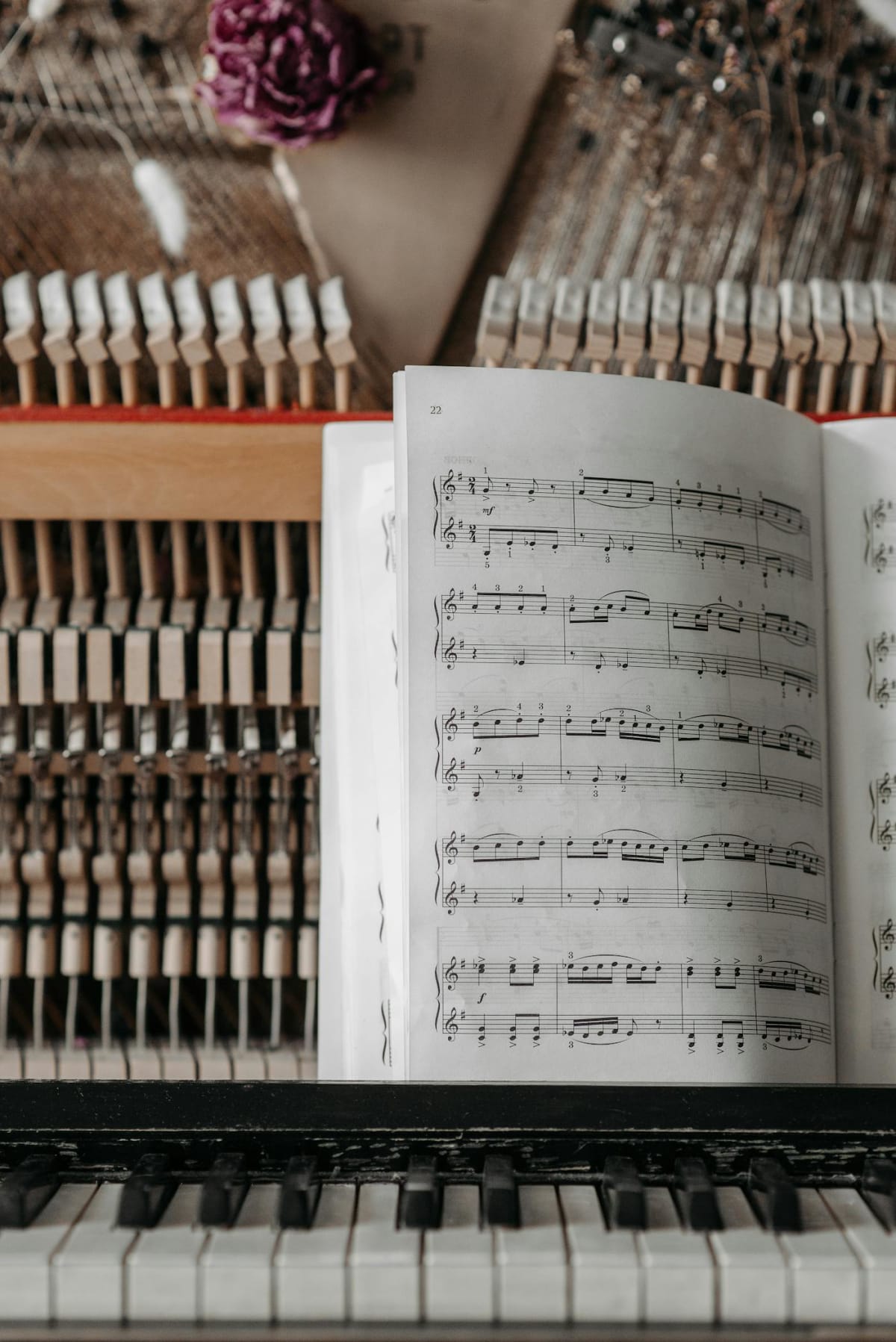
Photo: cottonbro studio via Pexels
Block 5 — Musicianship, 3 minutes
Three minutes feels too small to count, which is exactly why it is the right size for a habit. Rotate the work across the week: interval recognition on Monday, basic chord-quality identification on Tuesday, transposing a phrase from the current piece up or down a third on Wednesday, two minutes of focused listening to a recording of the current piece on Thursday, a quick harmonic analysis of one phrase on Friday. The Pract.is post on the 10-minute ear training routine is what this block expands into when you can give it more time on weekends.
Musicianship at the intermediate stage is no longer optional. Adult learners who skip it tend to plateau as "strong fingers, weak ears" players — competent at executing notes, slow to learn new music, lost when a piece moves outside their narrow harmonic comfort zone.
Block 6 — Review and next-day note, 2 minutes
Close the session with a single written line. What improved today, what is still failing, what should the first ten minutes of tomorrow's session look like. Two minutes is enough. A paper notebook works. A practice tracker like Pract.is works and starts paying off around month three, when patterns across weeks become visible. The Pract.is essay on using a practice log without turning it into homework covers what to track and what to skip.
Rotating the routine across the week
Doing exactly the same forty-five minutes seven days in a row is the recipe for resentment. The block structure should stay constant, but the focus inside the blocks should rotate. Three session archetypes cover almost everything an intermediate player needs.
| Day type | Frequency | What shifts inside the blocks |
|---|---|---|
| Deep work day | 3 per week | Repertoire block tilts to the hardest current piece. Isolation work dominates. Recording mandatory. |
| Balance day | 3 per week | Even split between current and polishing piece. Maintenance block runs through a different piece each day. Standard musicianship. |
| Low-energy day | 1 per week | Slow repertoire review only. No isolation work. Sight-reading and listening expand. Keep the streak alive. |
The third archetype is the one most intermediate players resist and the one that matters most for long-term consistency. The Pract.is article on what to do in practice when you're too tired covers why low-energy practice protects long-term progress better than perfect-or-nothing routines.
How this differs from the beginner routine
If you have come from the 30-minute beginner routine, the changes are real but additive. Technique becomes its own real block rather than a short orientation. Repertoire splits across two pieces minimum instead of one. A new maintenance block appears, because there is now something to maintain. Sight-reading expands and becomes daily and structured. Musicianship gets its first dedicated slot. The review note stays the same — small but load-bearing.
"A piece touched zero days a week is a piece quietly leaving your repertoire."
Common ways intermediates waste 45-minute sessions
A few specific failure patterns recur. The first is letting the warm-up scale block expand to fifteen minutes — usually a sign of resistance to the harder repertoire block that comes next. The second is repeating the current piece end-to-end three or four times instead of working the broken bars in isolation. The third is skipping the sight-reading block on the assumption that it is "extra"; six months later, reading fluency has not improved at all. The fourth is treating the maintenance block as optional, then being surprised when a piece learned six months ago needs two weeks of repair work for a casual request.
The deeper trap is the intermediate-specific one: practising the components that feel productive instead of the components that are productive. Long technique drills feel like work. Repeated full run-throughs feel like progress. Sight-reading and isolation practice feel slow and effortful, which is precisely why they are the parts of the routine you are most likely to skip. The Pract.is piece on why "just play it more" is bad practice advice covers this trap directly.
The version that actually lasts a year
The honest test of an intermediate routine is not whether it produces a great session on a well-rested Sunday. It is whether it survives a stressful Tuesday in month eight. Keep the blocks small enough that you can run a shortened version on a tired day — five minutes of technique, ten on repertoire, four on sight-reading, three on maintenance, two on review — without abandoning the structure entirely. A truncated session that touches every category beats a sixty-minute session that becomes one piece looped fifteen times.
The forty-five minutes you actually practise, six days a week, will move you further in a year than any aspirational schedule that exists only on paper. Intermediate progress is mostly about not letting the repertoire pool shrink while the current piece is under construction. The block plan above is built for that single, unglamorous job — and it is the difference between standing in the same place at year three and finding that you have quietly become the kind of pianist who can sit down at someone's piano and play.
More on practice methods.
A Practice Diary for Pianists: Turning Hours at the Keys Into Results
A piano practice diary can expose plateaus, strengthen memory, and protect sight-reading time. Learn what to record so each session changes the next.
Pract.is Editorial

Reading Your Practice Data: What the Numbers Actually Tell You
Practice statistics reveal coverage, spacing, effort, and trends. Learn to track practice progress without mistaking activity for musical improvement.
Pract.is Editorial

How to Build a Practice Routine You Actually Keep
A practice routine is easier to keep when its order stays fixed and its length can change. Build a schedule for sessions of 10, 25, or 45 minutes.
Pract.is Editorial