
Best Bluetooth Page Turner Pedals in 2026: AirTurn vs PageFlip vs Donner
The best Bluetooth page turner pedal depends on switch feel, power, and app mapping. Compare AirTurn, PageFlip, and Donner models from $50 to $130.
Pract.is Editorial
Research-based practice guidance for musicians from the Pract.is editorial team.
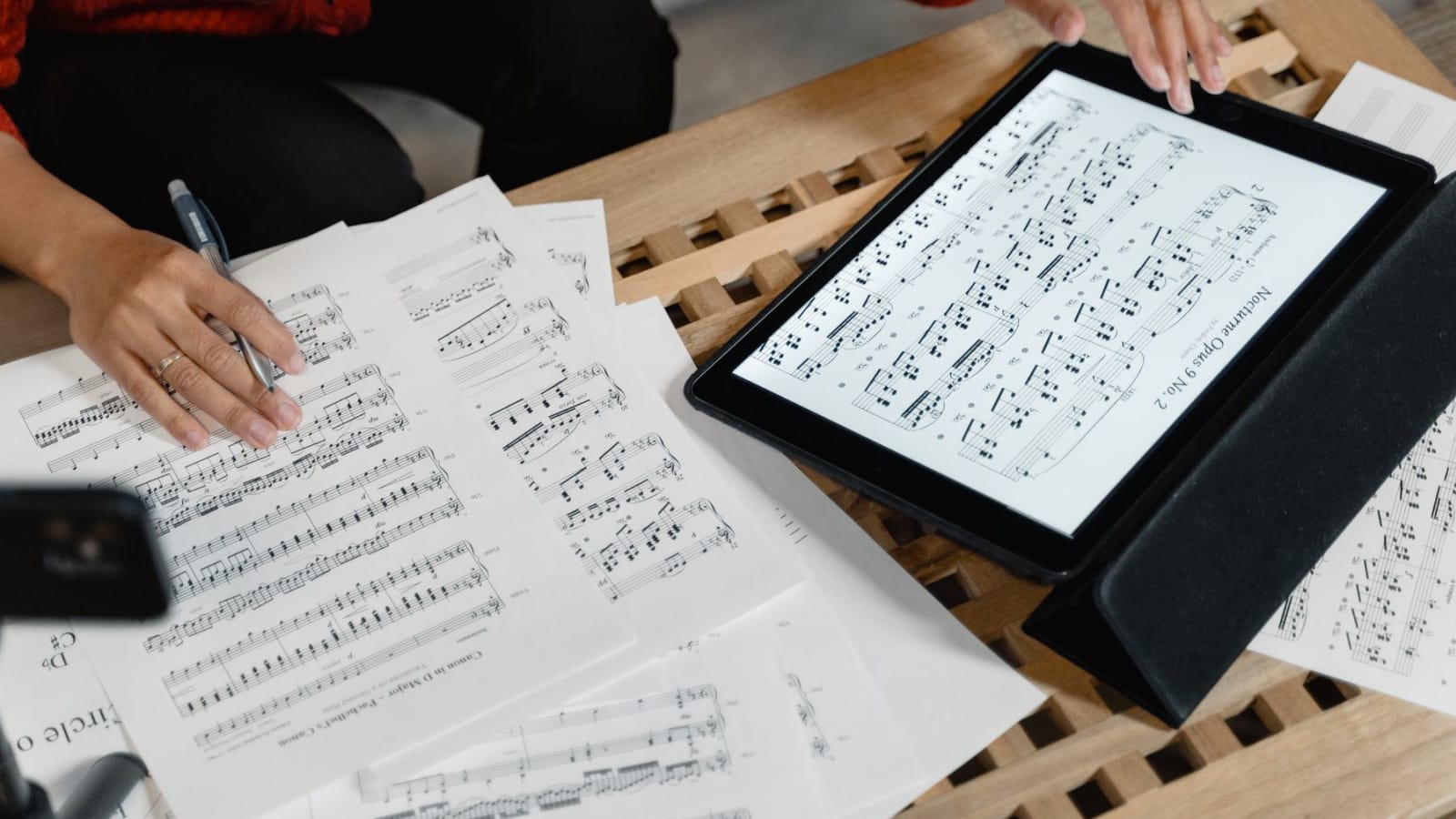
The best Bluetooth page turner pedal for most musicians is the AirTurn DUO 500 or PageFlip Firefly, but they win for different reasons: choose the DUO 500 for deep remapping, a rechargeable battery, and a lighter travel rig; choose the Firefly for large silent paddles, replaceable AA batteries, illuminated controls, and a real USB wired fallback. The Donner DBM-50 is the sensible budget buy when forward and back are the only jobs that matter.
That verdict is less about Bluetooth range than about what happens underfoot: the pedal must send a command the score app recognizes, wake when expected, stay where it was placed, and avoid an accidental repeat. Practis did not bench-test these models side by side; we compared current manufacturer documentation, app support pages, manuals, direct US prices, and an independent long-term comparison, with non-Amazon price snapshots checked on August 24, 2026.

A page turner is a keyboard with two enormous keys
Most Bluetooth page turners do not turn a page by understanding notation. They behave like small external keyboards. Press the right pedal and the device might emit a right-arrow, down-arrow, PageDown, Space, or Enter command. Press the left pedal and it emits the corresponding reverse command. The receiving app decides whether that key means next page, previous page, scroll, link jump, audio control, or nothing at all.
This distinction explains the most common setup failure. Seeing Connected in Bluetooth settings proves that the operating system can hear the controller. It does not prove that the selected pedal mode matches the shortcuts inside the score reader. forScore, for example, accepts several common arrow and page commands by default and allows extensive shortcut assignment. MobileSheets exposes its own pedal actions and can assign up to six switches. Newzik likewise documents both pairing and the correct command mode because those are separate steps.
“Pairing proves that the tablet can hear the pedal. It does not prove the score app understands what the pedal is saying.”
The same keyboard behavior creates a small iPad annoyance: the onscreen keyboard may disappear because iPadOS believes a physical keyboard is attached. The remedies are model-specific. Current PageFlip pedals can reveal it by pressing the active mode button, the Donner DBM-50 uses a hold on both pedals, and AirTurn offers its keyboard control or AirDirect route. That matters when naming a score or typing an annotation, even though it has nothing to do with page turning.
Two switches are sufficient for most players. One goes forward and one goes back. Four switches become useful only when the app can assign the extra pair to a real recurring action, such as jumping to a coda link, moving within a setlist, starting an audio track, or selecting an on-screen button. Buying four pedals before designing those actions usually creates a larger object and two unused switches.
AirTurn DUO 500 and PageFlip Firefly split the final
The AirTurn DUO 500 and PageFlip Firefly cost almost the same direct from their makers: $109 and $109.95 respectively on August 24. Their shared basics are strong. Both give the foot two generous targets, both are designed for quiet operation, and both support common score apps on tablets and computers. Their ownership models are almost opposites.
- 200+ hour manufacturer battery claim
- Seven modes, including AirDirect and MIDI
- Keys, macros, mouse, repeat, and debounce settings in AirTurn Manager
- 9 oz; 7 × 4 × 1 in
- USB-C charges it, but is not documented as wired control
- 200-hour manufacturer battery claim from two AA cells
- Five programmable profiles and illuminated paddles
- Bluetooth or genuine USB-C wired control
- 15.2 oz; 6.8 × 5.8 × 1.4 in
- Two auxiliary inputs can add external switches
AirTurn is the more flexible control platform. Its Manager app can change emitted keystrokes and more advanced behavior, while AirDirect gives supported apps a route that avoids some ordinary keyboard limitations. The DUO 500 also claims more than 200 feet of range, though ordinary music use rarely needs anything close to that. Its rechargeable battery and compact 9-ounce body make more sense in a tightly packed case.
There is one forScore-specific detail worth learning before a job. forScore recommends AirDirect in AirTurn Mode 1. When a player instead uses a standard keyboard mode, forScore says AirTurn Support should be disabled to prevent two systems from responding to the same press. That sounds technical, but it is a one-time configuration choice rather than a flaw.
PageFlip takes the reassuring hardware route. The Firefly is heavier, uses AA batteries that can be replaced seconds before a set, illuminates both paddles, and can send its commands over USB-C when Bluetooth is undesirable. The USB cable can also power it, but it does not recharge the AA cells. Current V14-or-newer Firefly units can be programmed with PageFlip's mobile app; older stock requires the Mac or Windows utility. Buyers receiving old stock should check the version label underneath.
Our default remains consistent with the broader iPad sheet-music setup: the Firefly is the conservative home and stage choice, while the DUO 500 is the better travel and customization choice. Neither is universally superior because a replaceable cell and a wired data path solve a different problem from a lighter rechargeable controller with advanced mapping.
Donner DBM-50 is the budget answer
The Donner DBM-50 was $49.99 direct when checked, less than half the price of either finalist. It provides two pedals, five fixed keyboard or mouse mappings, Bluetooth 5, a three-bar battery indicator, and an 80-hour manufacturer battery claim. Its documented wireless range is 10 meters, or about 33 feet. That is short beside AirTurn's advertised figure and still ample for a pedal sitting below the tablet it controls.
This is also the Donner model to choose over the older DBM-10 at current direct prices. The DBM-10 was $69.99, claims more than 50 hours, and lacks the DBM-50's clearer battery display. The newer pedal adds a dual-pedal gesture to reveal the virtual keyboard and explicitly describes its quiet mechanism. Its USB connection is for charging; Donner does not document a wired control mode.
The compromise is not that the DBM-50 is too simple to turn pages. It is that its five mappings are fixed. There is no AirTurn-style macro or MIDI layer, no PageFlip-style wired data fallback, and no extra pair of switches. Donner also lists IP3X, which means resistance to some larger solid objects. It is not a water rating, and it does not make the pedal spill-proof or dust-tight.
For a student reading PDFs at home, a singer scrolling lyrics, or a player who only wants reliable previous and next commands, those omissions may be irrelevant. Spend the roughly $59 to $60 difference only when the extra money buys a behavior the setup will actually use.
The specialist models solve narrower jobs
Three alternatives make sense after the main verdict, but each needs a specific reason.
PageFlip Butterfly, $89.95: this is the simple AA-powered choice. It has two large silent paddles, three fixed modes, a 200-hour claim, and the same 30-minute sleep behavior as PageFlip's more expensive models. It has no illumination, programming, auxiliary inputs, or wired operation. Choose it when predictable forward and back commands are the whole brief and a replaceable battery matters more than customization.
AirTurn PED 500, $89: at 5.3 ounces, this is the lightest option in the shortlist. It retains AirTurn's seven modes, AirDirect support, and customization while replacing the DUO's two raised pedal caps with a very slim touch surface. AirTurn describes its action as quiet-tactile, not completely silent. It makes sense for the smallest case or stand tray, while the DUO's more defined pedal shapes will look more familiar to players who want two obvious targets without looking down.
PageFlip Dragonfly, $129.95: this integrates four illuminated silent pedals into a footprint only a little wider than the Firefly. Two large lower switches can turn pages while two smaller upper switches handle link jumps, setlist actions, audio, or volume. Current V5-or-newer units use PageFlip's mobile programming app; older units need the desktop utility. The Dragonfly earns its extra bulk only after the other two commands have been named.
The direct prices below were checked on August 24, 2026 and are included as reference points, not claims about Amazon pricing or availability.
Affiliate notice: Some links are paid links. As an Amazon Associate, we earn from qualifying purchases.
The app decides whether two or four switches matter
Hardware compatibility should be described in commands, not in logos. A product page may list iPad, Android, Windows, and dozens of score apps, yet the pedal is still sending ordinary keypresses in most modes. That broad compatibility is real only when the app responds to those keys or lets the user map them.
| Reader | Common starting command | Why extra switches may help | Watch for |
|---|---|---|---|
| forScore iPhone / iPad / Mac | Arrow or PageUp/PageDown; AirDirect for supported AirTurn models | Link jumps, buttons, setlists, audio, and many assignable shortcuts | Do not leave AirTurn Support and a keyboard mode responding twice |
| MobileSheets Android / Windows | Assign each pedal in settings | Up to six switches can trigger turns, links, smart buttons, audio, and more | A device being paired does not assign its actions automatically |
| Newzik Apple devices | Arrow, PageUp/PageDown, or the maker-specific recommended mode | Hands-free navigation and app-specific pedal actions | The wrong mode can be connected and still do nothing useful |
| Practis Score Web | Arrow keys, PageUp/PageDown, Enter, or Space | Forward and reverse score navigation | Advanced pedal mapping and stage workflows are less mature than forScore or MobileSheets |
That last row is our own product, so it deserves plain language. Practis Score accepts common keyboard-style page-turn commands, including arrow keys, PageUp and PageDown, Enter, and Space. It deliberately avoids intercepting those keys while the user is typing in a field or activating an interface control. It does not yet match the advanced pedal mapping and performance tooling of forScore or MobileSheets. A conventional two-button pedal is the appropriate companion today.
Readers still choosing software can compare the larger ecosystems in our forScore, Newzik, and Piascore comparison. Android and Windows players should start with the forScore alternatives guide, while occasional readers may find that one of the free sheet-music readers already accepts the simple keys their pedal sends.
Reliability begins after pairing
A Bluetooth pedal usually fails in boring, repeatable ways. It wakes on the first press instead of turning, remains paired to the wrong tablet, sends the wrong arrow profile, repeats a held command, or runs out of power. None is dramatic at home. Any one can become the only thing the audience notices when it produces a three-second pause.
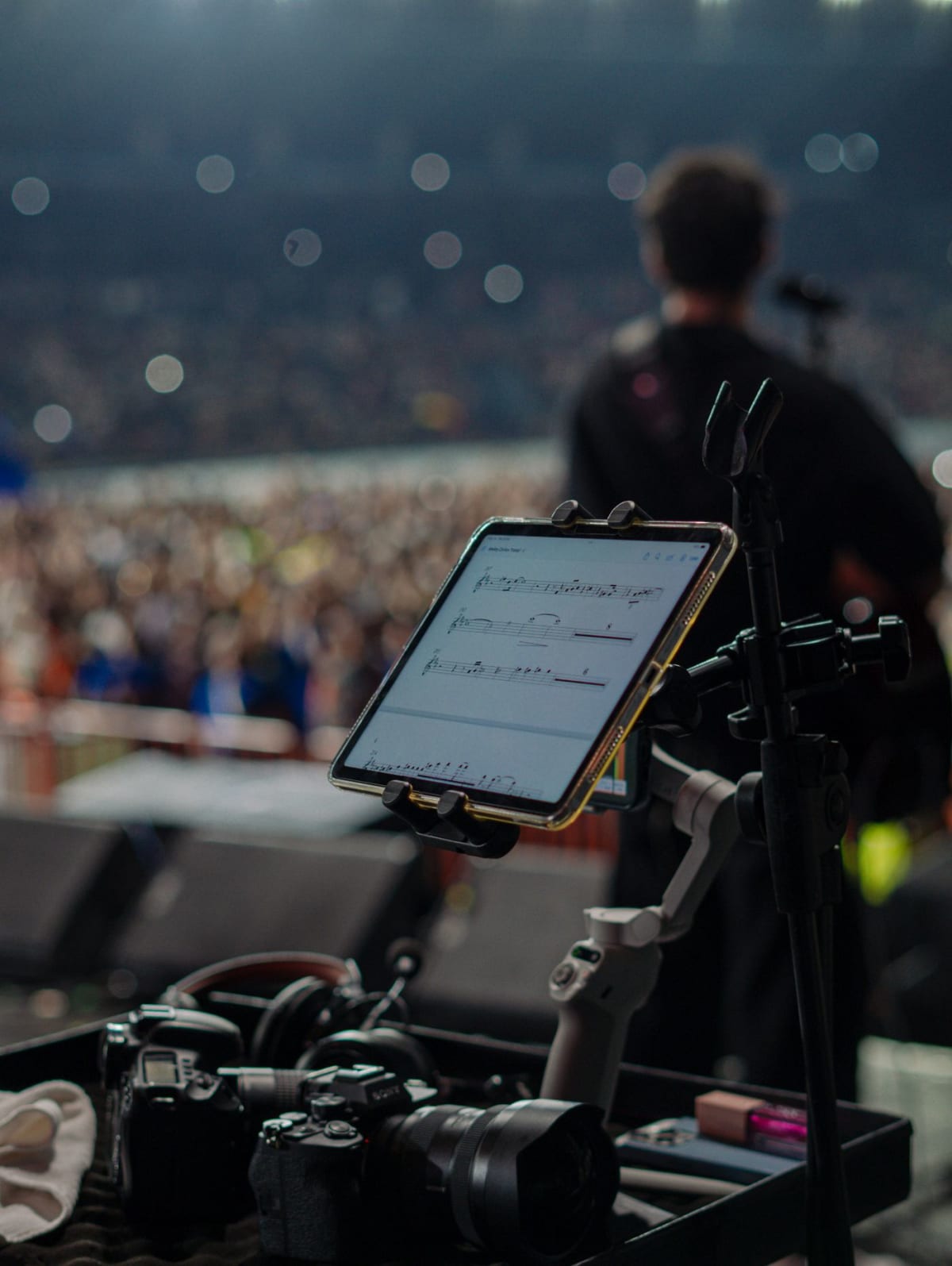
PageFlip pedals sleep after 30 minutes on batteries and may take up to about three seconds to wake. Their official FAQ says the sleep behavior cannot be disabled in battery mode; the Firefly and Dragonfly stay awake when powered by USB. The Donner DBM-50 also sleeps after inactivity and wakes from a pedal press. AirTurn exposes more idle-time control in its Manager settings. The point is not to fear sleep, but to incorporate it into the performance routine.
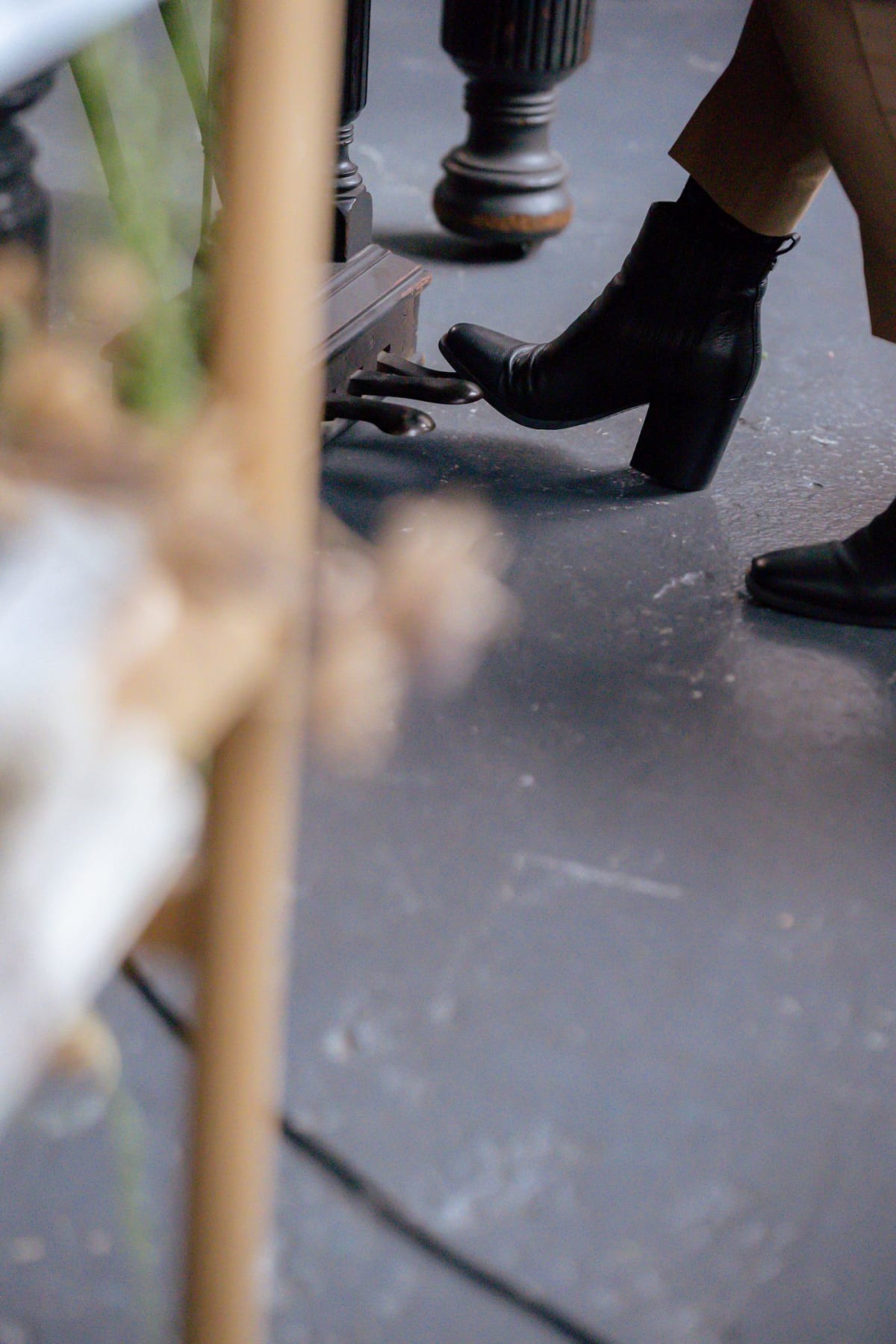
“Onstage reliability is rehearsal memory: same mode, same device, same wake test, every time.”
Physical placement completes the setup. Put the pedal where the free foot lands naturally, not where it makes the photograph symmetrical. Pianists need separation from the instrument pedals. Organists may have no free foot at all and might prefer a hand switch, facial gesture, automatic half-page turn, or a carefully mapped extra control. Violinists and wind players often benefit most because removing a hand from the instrument is disproportionately disruptive.
The final rehearsal should use the actual set, tablet, app, and footwear. Turn several pages in both directions, wait long enough to test the wake plan, enter and exit annotations, and confirm that the virtual keyboard can be restored. If a four-pedal model is involved, say each extra action aloud while testing it. A function that cannot be remembered under low light should not occupy a stage switch.
The buying decision can stay simple. Choose the PageFlip Firefly when silent large targets, AA recovery, lights, and wired USB are worth $109.95. Choose the AirTurn DUO 500 when custom commands, AirDirect, a rechargeable battery, and a smaller travel footprint are worth $109. Choose the Donner DBM-50 when the job is forward and back and $49.99 should solve it. Move to the Butterfly only for purposeful simplicity, the PED 500 for minimum weight, or the Dragonfly after assigning all four controls.
A pedal removes one interruption; it does not organize the practice around the score. A Practis plan can keep goals, notes, recordings, and session history together while the score reader handles page navigation. The best page turner is ultimately the one whose mode and wake behavior become so familiar that the player stops thinking about it.
More on setup.

Silent Piano vs Digital: Is a Hybrid Piano Worth It?
Silent piano vs digital piano: compare action, headphone noise, upkeep, prices, and whether a hybrid earns its premium for shared-home practice.
Pract.is Editorial
61 vs 76 vs 88 Keys: Which Keyboard Size Is Right?
61 vs 76 vs 88 keys comes down to range, action, and space. Compare each size by repertoire, portability, and three current keyboard examples.
Pract.is Editorial

Best Keyboard Gig Bags and Cases in 2026: 61- and 88-Key Picks
Compare the best keyboard gig bags and cases for 61- and 88-key boards, with current prices, interior dimensions, case weights, and airline guidance.
Pract.is Editorial