
Best Music Stands in 2026: Manhasset vs Folding and Desktop
The best music stand depends on what folds and what the score needs. Compare six desktop, wire, collapsible, and orchestra models from $20 to $73.
Pract.is Editorial
Research-based practice guidance for musicians from the Pract.is editorial team.

The best music stand for most players who practise in one room is the Manhasset Model 48 Symphony. Its full desk, welded fixed base, and one-hand friction adjustments make daily use easier than a folding wire stand; choose wire only for small-bag transport, a collapsible panel when travel and page support matter equally, and desktop only when a suitable table already exists.
“Folding” does not describe one design: a wire desk can fold, a solid desk can collapse into panels, or only the tripod can close while the desk stays full-size. Practis did not bench-test these six models side by side; we compared current manufacturer specifications, manuals, warranties, adjustment systems, and US non-Amazon prices checked on August 24, 2026.
These four designs reach storage size in different ways. The desk is the part the score actually feels.
“Folding” does not describe one kind of stand
A music stand performs three separate jobs. The desk supports the score, the shaft puts it at reading height, and the base keeps that load over the floor. Each part can be optimized for use or for storage, but usually not both. A continuous 20-inch desk supports a book naturally and accepts a clip-on light. A wire frame can disappear into a 24-inch bag, but asks a few narrow bars and page arms to do the supporting.
That is why a $20 wire stand is not simply a cheaper $64 Manhasset. They make opposite promises. The Manhasset gives up compact transport so that its desk and base are ready whenever the player walks into the room. The wire stand gives up continuous support so it can travel beside an instrument. The correct comparison begins with where the stand goes after practice, not with its maximum height.
“A folding wire stand is not a cheaper orchestra stand. It is a different answer to the storage problem.”
“Orchestra grade” is not a regulated certification. We use it here to describe the practical traits an ensemble, school, or busy studio benefits from: a full desk, fast repeatable adjustment, parts that can be serviced, and a base and storage system designed for repeated handling. A label alone cannot establish those qualities, and a fixed orchestra stand is not automatically right for a player who walks to lessons.
Start with the thickest score you actually use
Loose pages are easy. A thick anthology, spiral method book, two-page folder, tablet, pencil tray, and clip-on light create different loads. Measure the open score, including its spine, and look at where its back will touch the desk. A quoted desk width can be misleading when most of that width is air between wire arms. Lip depth matters too: two inches is comfortable for ordinary music and folders, while a shallow or interrupted ledge can let a rounded spine push forward.
A continuous panel spreads the score's back over a broad surface. It also makes page marking and erasing less frustrating because the paper has support behind it. Wire designs reduce weight and packed bulk, but a small book can fall between their supports and a soft folder may bow around them. Fold-out page arms help hold loose sheets side by side; they do not turn the desk into a solid panel.

A tablet changes the brief again. Its concentrated weight, case thickness, charging cable, and smooth back need a sufficiently deep lip and sensible balance. A published load capacity is useful, but it is not a tip-resistance rating. Our complete iPad sheet-music setup covers holders, clamps, and the floor-level cable problem in detail. If the purpose of the stand is already digital performance, our Bluetooth page-turner comparison handles the next part of that system.
Six current models, matched to six jobs
The range below is deliberately not a simple quality ladder. Prices are current US manufacturer or specialist-retailer snapshots checked on August 24, 2026. They are not Amazon prices and do not promise future stock. Dimensions, weights, and capacities are maker-published unless a retailer is named.
Affiliate notice: Some links are paid links. As an Amazon Associate, we earn from qualifying purchases.
-
Best fixed stand overallManhasset Model 48 Symphony20 × 12.5 in desk · 7.5 lb · fixed welded base · $63.52View on Amazon ↗
-
Best full desk for car travelOn-Stage SM7211B19 × 13.5 in full desk · 24–45 in high · folding tripod · $55.56View on Amazon ↗
-
Best collapsible middle groundPeak SMS-20Five-panel desk · 4.9 lb · bag included · from $49.95 directView on Amazon ↗
-
Best premium folding wireK&M 1006519.29 in folded · 3.42 lb · 4.4 lb maker capacity · $72.99View on Amazon ↗
-
Best budget folding wireOn-Stage SM7122BB26–40 in high · 2.6 lb retailer weight · bag included · $19.95View on Amazon ↗
-
Best desktop standHercules BS010BB16.1 × 9.3 in desk · 1.15 lb · bag included · $21.99View on Amazon ↗
Desktop stands borrow stability from the furniture
The Hercules BS010BB is the cleanest choice when floor space is unavailable and the practice surface is already suitable. Its 16.1-by-9.3-inch desk, four page retainers, 180-degree rear support, 4.41-pound maker capacity, and 1.15-pound weight create a genuinely compact travel tool. Folded, it measures about 16.9 by 3.5 by 1.9 inches and fits into the included bag.
But “desktop” removes the shaft and base rather than solving them. Reading height now depends on the table, piano lid, cabinet, or hotel desk underneath it. A deep table can force the player too far from the score; a narrow table can leave the rear support close to an edge. A light folding table can move even when the desktop stand itself is sound. The supporting surface must be level, large enough for the rubber foot and rear prop, and positioned so the player can keep a neutral head and spine.
This type is excellent for score study, conducting preparation, hotel practice, and any seated task with a well-placed desk. It is a poor substitute for a floor stand beside a cello, standing wind player, or keyboard whose top surface is needed for controls and speakers. It also cannot float above pedals or move independently of the furniture. The tabletop is part of the product whether the box acknowledges it or not.
Wire stands trade desk support for a smaller case
The On-Stage SM7122BB is the honest $20 answer for lessons, loose pages, and light folders. Its two-section shaft adjusts from 26 to 40 inches, the base spreads from 18 to 21 inches, and the folding bookplate uses six hinged points plus extendable arms to display up to three letter-size sheets. A carrying bag is included. B&H publishes a 2.6-pound stand weight; On-Stage does not publish a maximum load.
Those omissions matter. The SM7122BB should not be treated as a cheap tablet stand or a home for a heavy bound score. Its value is that a beginner can carry instrument and stand without adding a rigid full-size desk. Open every hinge fully, spread the base, tighten the angle joint, and center the page load before use. If the score bows, rotates the desk forward, or needs several improvised clips to stay put, the format has outgrown the stand.

The K&M 10065 is the premium version of the same travel idea. It weighs 3.42 pounds, folds to 19.29 inches, and provides a 19.09-by-9.45-inch steel desk. The three-piece shaft ranges from 23.03 to 48.03 inches, its base diameter is 27.17 inches, and K&M publishes a 4.4-pound load capacity. The U-profile legs, toothed angle joint, and non-scratching locks are meaningful refinements. The carrying case is optional rather than included.
At $72.99, the K&M costs more than the Manhasset Model 48. That does not make it a better room stand. It makes it a better-specified wire stand for someone who values a 19.29-inch folded length, 3.42-pound carry, wide published height range, and stated load. Buy the K&M for transport. If it will remain open in a practice room, the Manhasset's continuous desk and one-hand adjustments are the better use of less money.
Collapsible panels are the useful middle
The Peak SMS-20 places five folding panels behind the score instead of leaving a conventional wire skeleton. Slide out its tray and the desk collapses for the included bag. Quick-clamp levers control its tubular steel frame, maximum height to the bottom of the desk is 47 inches, and total weight is 4.9 pounds. Peak provides a one-year warranty but does not publish the minimum height, desk dimensions, folded dimensions, or load rating.
That makes the Peak a sensible choice for a player who transports method books and folders but cannot carry a full orchestra desk. It is not especially light, and its hinged panels plus removable tray create more setup steps than a fixed stand. Still, it gives the score more continuous support than open wire. It is the compromise we would choose before asking a basic travel stand to hold a job it was not built for.
The On-Stage SM7211B takes the opposite route. Its 19-by-13.5-inch full desk does not fold; it detaches from the shaft while the tripod closes. The lip is two inches deep and height runs from 24 to 45 inches, but On-Stage does not publish a load capacity for this model. This is car-portable rather than shoulder-bag portable. It suits a conductor, rehearsal room, or player who wants a full desk at the destination and has somewhere to put that panel in transit.
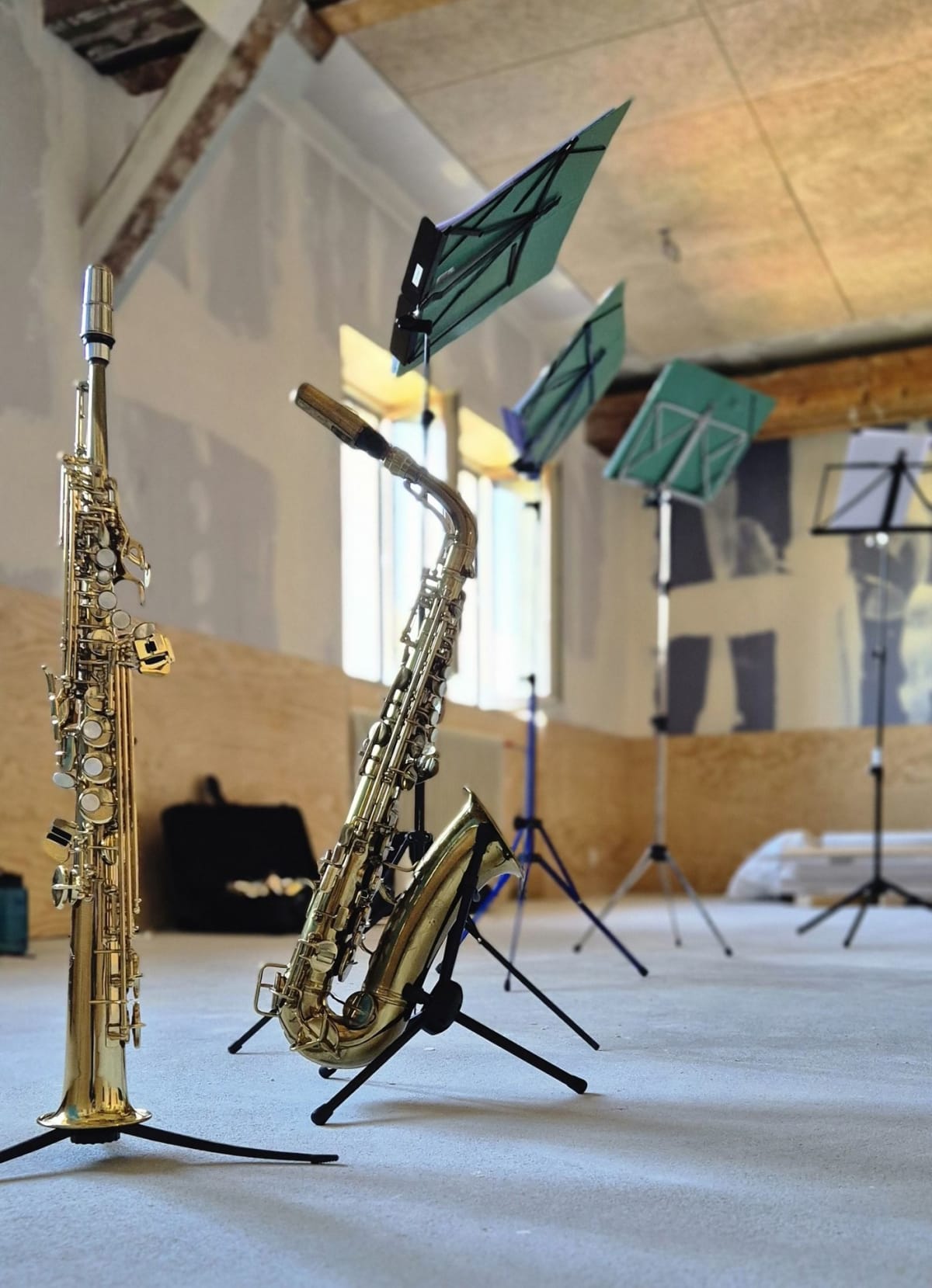
“Portable has two meanings: light enough to carry and small enough to fit. A stand can succeed at one and fail at the other.”
Manhasset wins when the stand can stay put
The Manhasset Model 48 is the best overall pick because it removes small irritations from an object used every day. Its ribbed aluminum desk measures 20 by 12.5 inches with a 2.25-inch ledge. The ledge adjusts from 26 to 48 inches, maximum overall height is 60.5 inches, and the complete stand weighs 7.5 pounds. The desk tilts through a friction system with no tightening knob, while the height shaft moves with one hand through Manhasset's friction clutch.
The base is a welded steel tripod and does not collapse for ordinary transport. That is the limitation and the advantage. There are no folding legs to open for each practice session, no desk to unfold, and no bag to find. The official catalog lists replacement parts and a lifetime warranty, subject to Manhasset's terms. The maker also warns owners not to lubricate the chrome height shaft because lubricant can reduce the clutch's holding friction.
Its $63.52 current retailer price also sharpens the Manhasset-versus-folding verdict. The Model 48 costs about $9 less than the K&M 10065, yet provides the fuller everyday desk and quicker adjustment. It loses only when storage depth or transport governs the decision. A school buying many stands should also think beyond the individual unit: dollies, room layout, replacement desks, shafts, and bases determine whether “orchestra grade” works as a maintainable system.
No load capacity is published for the Model 48, so we will not invent one or call it impossible to tip. A clip-on light, thick score, tablet, or extension adds mass and leverage. Keep the load centered, check that the desk holds its chosen angle, plant all three feet on a level surface, and keep the base out of aisles. A full desk can also catch wind outdoors. Fixed does not mean windproof.
Set the score around the player
A stand can fit the book and still place the body badly. Set the chair, instrument, and playing position first. Then raise and angle the score so the head can remain close to neutral and the eyes can move between notation, instrument, conductor, and room without a repeated forward crane. The Musicians' Union posture guide advises adjusting playing equipment, including stands, to improve posture; the exact position still depends on the instrument and task.
For a seated player, confirm that the base clears chair legs, feet, bow path, bell, and pedals. For a standing player, check the base at the actual playing distance rather than placing it directly between the feet. Lower is not automatically better, especially if it rounds the upper back; higher is not automatically better if the desk blocks the conductor or forces the instrument into an awkward angle. The target is a supported playing position, not a universal measurement.
Open and adjust folding stands without the score loaded. Fully spread the legs, seat toothed joints before tightening them, lock every clamp, and inspect hinge points for trapped fingers. Outdoors, use suitable page clips and seek shelter from gusts. Do not hang an instrument case from the shaft as ballast. It shifts weight away from the center and creates another trip point. A heavy full desk may catch more wind than a wire one, so judgment matters more than the product category.
If the real goal is to leave paper behind, choose that workflow deliberately. Our sheet-music app comparison separates display libraries from practice-aware tools. Once the physical reading setup is settled, a Practis plan can keep the score, goals, session notes, recordings, and practice history connected instead of letting the stand become the most organized part of the routine.
Start with the room, not the catalogue. If the stand can remain open, choose the Model 48; if it must travel, measure both the thickest score and the available storage space before ordering. The best music stand is the one whose compromises happen after the rehearsal, not during it.
More on setup.
Silent Piano vs Digital: Is a Hybrid Piano Worth It?
Silent piano vs digital piano: compare action, headphone noise, upkeep, prices, and whether a hybrid earns its premium for shared-home practice.
Pract.is Editorial
61 vs 76 vs 88 Keys: Which Keyboard Size Is Right?
61 vs 76 vs 88 keys comes down to range, action, and space. Compare each size by repertoire, portability, and three current keyboard examples.
Pract.is Editorial

Best Keyboard Gig Bags and Cases in 2026: 61- and 88-Key Picks
Compare the best keyboard gig bags and cases for 61- and 88-key boards, with current prices, interior dimensions, case weights, and airline guidance.
Pract.is Editorial