
Preparing for a Conservatory Audition Online: What Actually Matters
The modern conservatory audition begins with a video you record at home and increasingly ends on a screen too — which quietly makes online preparation the native fit, not the fallback. What panels actually reward, what students waste months on, and how to prepare for both.
Pract.is Editorial
Research-based practice guidance for musicians from the Pract.is editorial team.
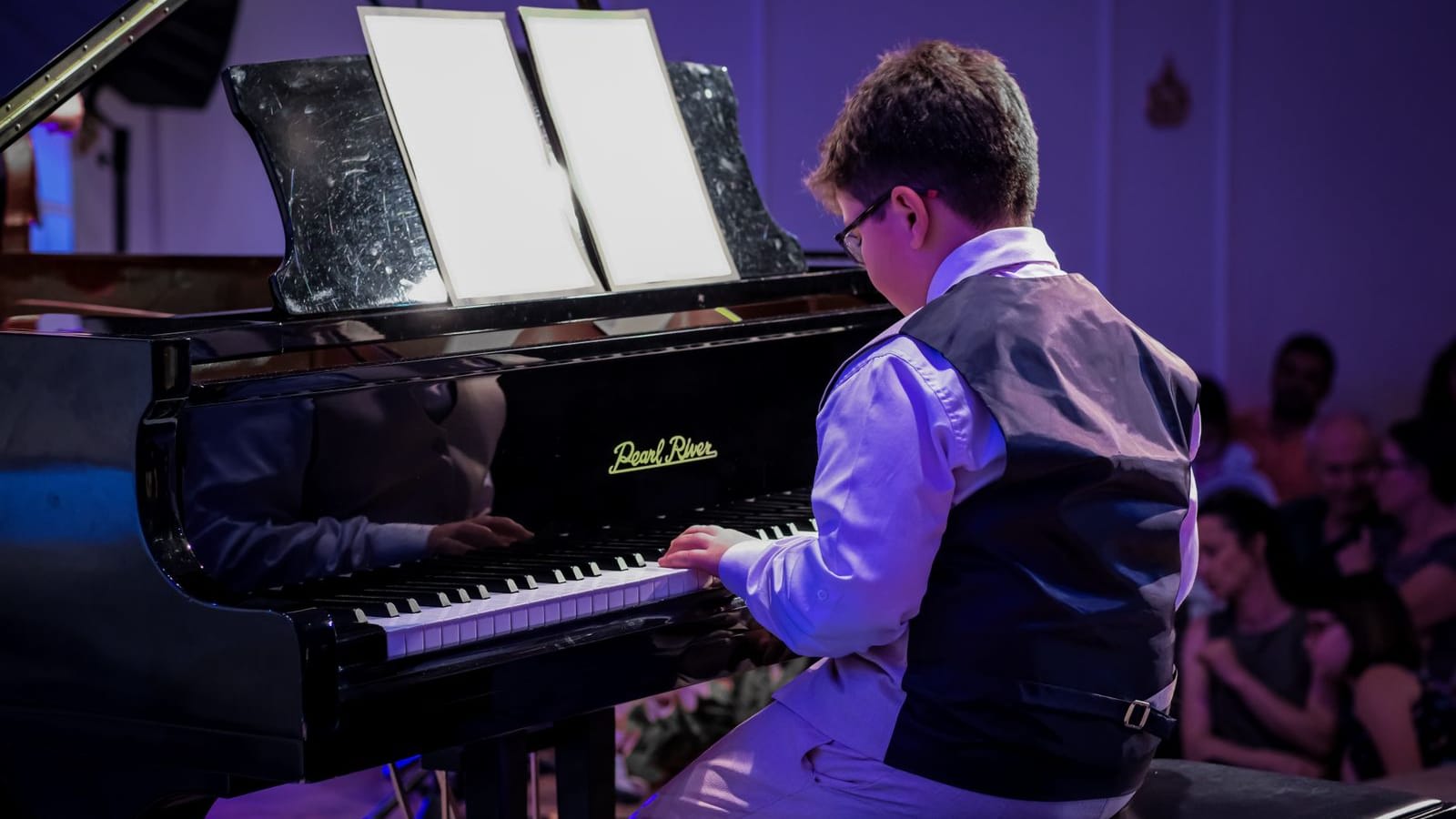
A conservatory audition can feel like the one moment where nothing but an elite teacher in the room will do — the stakes are a place at a great school, and the instinct says proximity, prestige, presence. So it surprises people to learn that the modern audition has quietly moved onto a screen at both ends. The first gate is a video you record at home; the live round that follows is, at many schools, now held over Zoom. The audition process itself went online before most applicants did — which makes preparing for it online the native approach, not a compromise you settle for.
That's the practical case. The more important one is about substance: most applicants spend their preparation optimising the thing panels weigh less than expected, and neglecting the things that actually decide it. Here's what a conservatory audition really involves in 2026, what the people behind the table are listening for, and how to prepare for every stage of it — recording included.
The two gates most applicants underestimate
Nearly every conservatory now runs a prescreening round before it will offer a live audition. You submit recorded video of your required repertoire, and a faculty panel decides from that alone whether to invite you further. This gate is brutal and underestimated: a large share of applicants are cut here, on a recording, before any human hears them in real time. Only those who pass reach the live audition — on campus, or, increasingly, over a scheduled video call.
The standards for that prescreening video are specific and non-negotiable, and they're worth knowing early because they shape how you practise. Drawing on published requirements from schools like the Manhattan School of Music and others, the common rules run like this: the camera must clearly show your face, hands on the keys, and feet on the pedals; each piece is a separate, unedited take (no splicing, no studio trickery); audio should be clean and honest rather than professionally produced; and repertoire is typically performed from memory. Requirements vary by school and change yearly, so every program's own page is the final word — but the shape is consistent, and it happens to describe a skill set an online teacher coaches every week.
| Stage | What it is | Where online prep helps most |
|---|---|---|
| Prescreening | Recorded video, judged blind | Recording craft: camera, takes, take selection |
| Live audition | On campus or over Zoom | Mock auditions in the exact medium |
| Interview / musicianship | Talking about your playing | Rehearsing how you articulate choices |
What the panel is actually listening for
This is where preparation goes right or wrong, and it's counterintuitive. Ask applicants what they're working on and most say the same thing: playing the notes perfectly. Ask admissions faculty what separates the students they invite from the ones they don't, and you hear something different — they want, in the phrase that recurs across their own guidance, a musician with something to say. Note-perfection is table stakes at this level; nearly everyone in the pile can play the notes. What distinguishes an applicant is musical narrative: interpretive choices made deliberately, phrasing that means something, the sense of a point of view. Panels reward the student who can not only play a Chopin ballade but tell you why they shape that transition the way they do — and then prove it at the keyboard.
Alongside artistry, faculty are reading presence: how you carry yourself, whether you project confidence without arrogance, and — critically — how you recover from a slip. A memory stumble handled with composure often reads better than a nervous, flawless run, because it signals a performer rather than a machine. The uncomfortable truth for the note-obsessed applicant is that the last five per cent of technical polish, the part that eats the most practice hours, moves the needle less than developing an actual interpretation and the poise to deliver it.
| What applicants over-practise | What panels actually weigh |
|---|---|
| The last 5% of note-accuracy | A convincing interpretation |
| Playing faster than required | Phrasing, colour, and control |
| Hiding every weakness | Composure and graceful recovery |
| Impressive but generic repertoire | Programme that shows range & a voice |
"Everyone in the pile can play the notes. The panel is listening for a musician with something to say — and the poise to say it after a slip."
Building a programme that speaks
Repertoire is strategy, not just a checklist. Conservatory requirements typically ask for contrast across musical periods — commonly a Baroque work (a Bach prelude and fugue is close to standard), a Classical sonata movement (Mozart, Haydn, Beethoven), and Romantic or later repertoire — performed from memory, adding up to a set that shows range. Within those constraints, the choices are yours, and they're the first thing that tells a panel who you are. A programme assembled to look impressive reads as generic; one chosen because you have something to say about each piece reads as a musician. Some faculties explicitly welcome underrepresented composers — Florence Price, Clara Schumann, and others — both for the repertoire's own merit and because it shows a curatorial mind at work.
The role of a good teacher here isn't to hand you a safe list; it's to help you build a programme that plays to your strengths and carries your fingerprint, then to develop an interpretation of each piece deep enough that you could defend every choice in an interview. That work — repertoire strategy, interpretation, the ability to articulate it — transmits through a screen completely, because it lives in listening and conversation, not in a shared bench.
The audition prep timeline
Auditions reward runway. A realistic arc for a serious applicant starts roughly a year out, and an online teacher runs it exactly as an in-person one would:
A year out from a conservatory audition
Recording the prescreening, and mock auditions
Two preparation techniques decide more than any single practice session, and online teaching is unusually good at both. The first is recording the prescreening properly. Because the takes must be unedited, you're not capturing one perfect moment — you're building the reliability to deliver a whole piece cleanly on demand, then choosing your best honest take from several. An online teacher, who lives in the same recorded medium, coaches the whole craft: camera placement to the spec, honest audio, and above all the psychological skill of playing to a camera rather than freezing at it.
The second is the mock audition — and for the live round, running it over Zoom is the exact rehearsal, not an approximation. Full dress, walk in, announce your programme, play under pressure with no restarts, field a mock interview question about your interpretation, recover from a deliberate stumble. Do this enough times before it counts and the real audition becomes familiar rather than terrifying, which is more than half the battle at this level.
Prescreening recording: the checklist
"The prescreening isn't one perfect moment captured — it's the reliability to play a whole piece cleanly on demand, then pick your best honest take."
Choosing a teacher for this
Audition preparation is a specialty, not a generic lesson, and the online market is where you find the specialist rather than settling for the nearest option. You want someone who knows current conservatory requirements, has taken students through the process, and can develop interpretation to the depth a panel expects — the questions that expose a good online teacher apply doubly here, sharpened by asking directly about audition and conservatory-entrance experience. This is precisely the brief of our top pick among online piano teachers, PianoTechSupport — a Vienna-conservatory-trained pianist whose stated focus includes conservatory-entrance and audition preparation alongside ABRSM and Trinity grades, with trial lessons to gauge the fit before committing an audition year.
One more thing worth knowing about the schools you're auditioning for: the strongest programmes increasingly run on dedicated systems for tracking student practice and progress at scale — the same disciplined, documented approach to practice you'll build for your audition is what conservatories expect once you're in. Getting into the habit now, with a simple practice log that keeps your prep honest between lessons, is preparation for the audition and for the years that follow it.
Common questions
Will conservatories take me less seriously if I prepared online?
No — the panel assesses your playing and musicianship, not who taught you or how. Given that the prescreening is itself a home recording and many live rounds are on Zoom, faculty are entirely used to applicants prepared and auditioning remotely. What they notice is the quality of the interpretation and the reliability of the delivery, both of which online preparation builds as well as any studio.
How far ahead should I start preparing?
Ideally around a year for undergraduate auditions — long enough to choose repertoire, memorise it securely, develop a genuine interpretation, and run mock auditions before deadlines that typically fall in the winter. Prescreening deadlines often cluster in early December, so working backwards from that date for your target schools is the honest way to plan. Less runway is workable with existing repertoire, but interpretation and security are what time buys.
Do I need a grand piano to record the prescreening?
A good acoustic instrument helps, but panels know applicants record on what they have and judge the playing, not the piano. A well-maintained upright with honest audio and correct framing is entirely acceptable; a high-end digital is a workable last resort. Sound quality and clear video matter more than the instrument's prestige — obsessing over the piano is another way of avoiding the interpretation work that actually counts.
The version of the conservatory audition that demands an elite teacher two towns over, in person, weekly, for years, is not the one most applicants now face. The real one begins with a video at your own piano and often ends on a screen — and it is decided less by flawless notes than by whether you arrive as a musician with a point of view and the poise to deliver it. Prepare for that audition, with a specialist you can choose from anywhere, and the format you were anxious about turns out to be the one you'll perform in. Choose your programme, start the countdown, and give yourself something to say.
More on lessons.

Trusted Online Piano Lesson Providers in 2026 (And How to Vet Them)
Every affiliate list calls every provider "trusted." Trust isn't a vibe — it's a short set of things you can actually check. The signals that separate a trustworthy online piano provider from a slick one, and a vetted shortlist by category.
Pract.is Editorial

A Week Between Piano Lessons: How Good Teachers Structure Your Practice
Piano practice between lessons works best when the teacher leaves you with a result, a method, and evidence to bring back. Here is what a well-structured week looks like, even when the week itself is messy.
Pract.is Editorial

Why Your Self-Taught Piano Progress Stalled (And What a Teacher Sees in 10 Minutes)
Self-taught piano progress often stalls when the player creating the problem is also the only person trying to diagnose it. Here is what a teacher can see in ten minutes, how they test the cause, and how to turn one correction into a better month of practice.
Pract.is Editorial