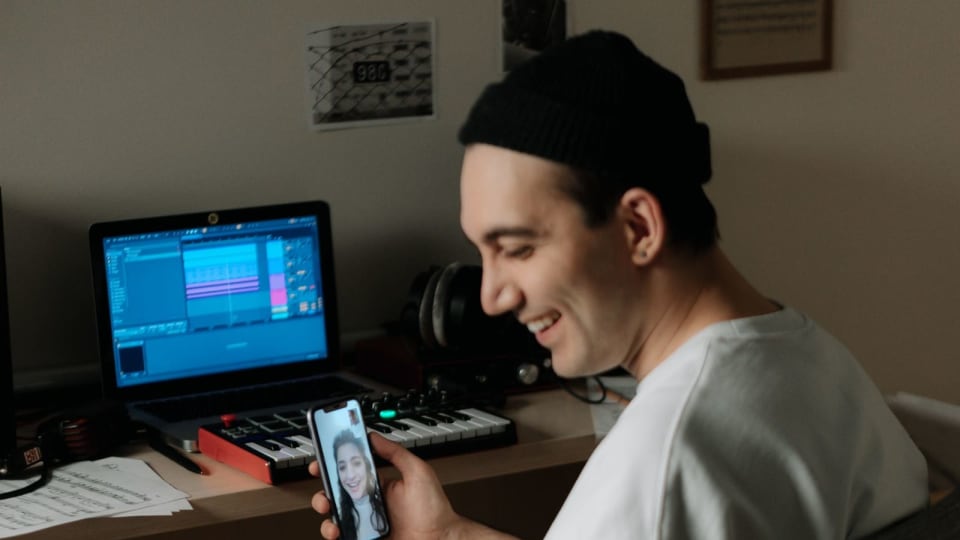
Most adults who consider piano lessons carry the same quiet assumption: online is the compromise version. Real lessons happen in a teacher's studio, the way they did when we were ten; Zoom is what you settle for. It's worth saying plainly that the opposite is closer to the truth — and not as a marketing flourish, but for a structural reason: almost everything the video format does badly is something children need, and almost everything it does well maps onto how adults actually learn.
The format didn't get built for adults on purpose. But look at where its friction sits and where its advantages sit, and it might as well have been. Here's the case — including the adult-specific fears nobody admits to, the learning science, and the honest caveats.
The fear adults don't say out loud
Ask adults why they haven't started lessons and you'll hear "time" and "money." Teach adults for a few years and you learn the real answer underneath: embarrassment. A grown professional — competent all day, respected at work — sitting at an instrument playing haltingly in front of another adult is, for many people, close to unbearable. Children don't carry this; being a beginner is their whole job. Adults have usually spent decades avoiding situations where they're visibly bad at something, and a stranger's studio is exactly such a situation.
Online lessons quietly dismantle most of that. You're in your own home, at your own instrument, in your own light. There's no waiting room, no one overhearing through the door, and the psychological exit is always one click away — which, paradoxically, makes people stay. Teachers who work with adult beginners consistently report the same thing: students who would never have walked into a studio will switch on a camera, and after three sessions the self-consciousness is gone either way. The format doesn't just tolerate adult vulnerability; it's the gentlest available on-ramp for it.
"Adults don't skip lessons because of time or money. They skip them because being watched while bad at something is the thing adulthood taught them to avoid."
Adults learn differently — and video favors the difference
The learning-science version of this argument has a name. Malcolm Knowles' theory of andragogy — how adults learn, as opposed to how children do — rests on a handful of well-replicated observations: adults are self-directed rather than dependent, they learn through and against their existing experience, they want to know why before they'll practise what, and they're driven by internal goals rather than external authority. Research on adult music students specifically (Leahy and Smith's 2021 study in the International Journal of Music Education) finds the same pattern: adult learners lean toward self-direction, and they thrive with teachers who accommodate it rather than direct every step.
Now put that beside what a video lesson is actually good at. The format's known weaknesses — a teacher can't physically place your hands, can't hold a wandering attention span with sheer presence, can't manage a squirming seven-year-old — are all pedagogy problems, children's-lesson problems. Its strengths are conversation, explanation, demonstration, and question-answering: precisely the verbal, conceptual, why-first channel that andragogy says adults learn through. A child needs a teacher in the room. An adult needs a knowledgeable person who explains clearly, listens well, and respects that the student will do the work alone between sessions. Video carries the second job at nearly full fidelity — which is exactly what the controlled comparisons found when they measured no skill difference between online and in-person students.
What each learner needs — and what video delivers
The format's famous weaknesses are children's needs. Its strengths are an adult's learning style, almost point for point.
Your adulthood is an asset, not a handicap
The "adults learn slower" folklore deserves direct demolition, because it quietly keeps people from starting. What adults lack is the child's neuroplastic sponge for raw motor patterns; what adults have is everything else, and the ledger favors them for years. You arrive with decades of trained listening — you already know what a phrase should sound like, what rushing feels like, when a chord is wrong, which is an inner ear children spend a decade building. You arrive with goal clarity: the adult who wants to play Chopin's E-minor prelude, or accompany their kid's choir, practises with an aim children rarely have. And you arrive with meta-learning skills from a career of acquiring things — you know how to schedule, how to break problems down, how to ask a precise question, how to notice when a method isn't working. Knowles' experience pillar isn't a consolation prize; it's the reason adult beginners routinely outpace children through the first year or two of study.
Every one of those assets, notice, transmits perfectly through a screen. Taste, goals, questions, and self-management need a conversation, not a shared room. The one advantage children keep — faster raw motor absorption — is precisely the slow, repetition-built layer that happens in your practice week anyway, not in the lesson. The lesson is where the adult advantages live, and the adult advantages are video-native.
The logistics finally fit a real life
The second structural favor the format does adults is boringly practical. Adult progress lives or dies on consistency — and the thing that kills adult lesson schedules is never desire, it's friction: the commute that turns a 45-minute lesson into a two-hour errand, the work call that ran over, the school pickup. Online lessons strip most of that friction out. The lesson happens in the gap between dinner and bedtime, from a hotel on a work trip, on the instrument you actually practise on. Miss-and-reschedule becomes a message instead of a lost week. Over a year, that difference compounds into something bigger than any pedagogical nuance: remote adult students simply accumulate more lessons.
And the money logic lands differently for adults too: at 2026 rates, online teaching runs $15–30 an hour below equivalent in-person lessons, and the world-wide teacher pool means an adult with specific tastes — jazz voicings, exam preparation, a certain temperament — can actually find their match instead of settling for proximity.
The rewind button (use it)
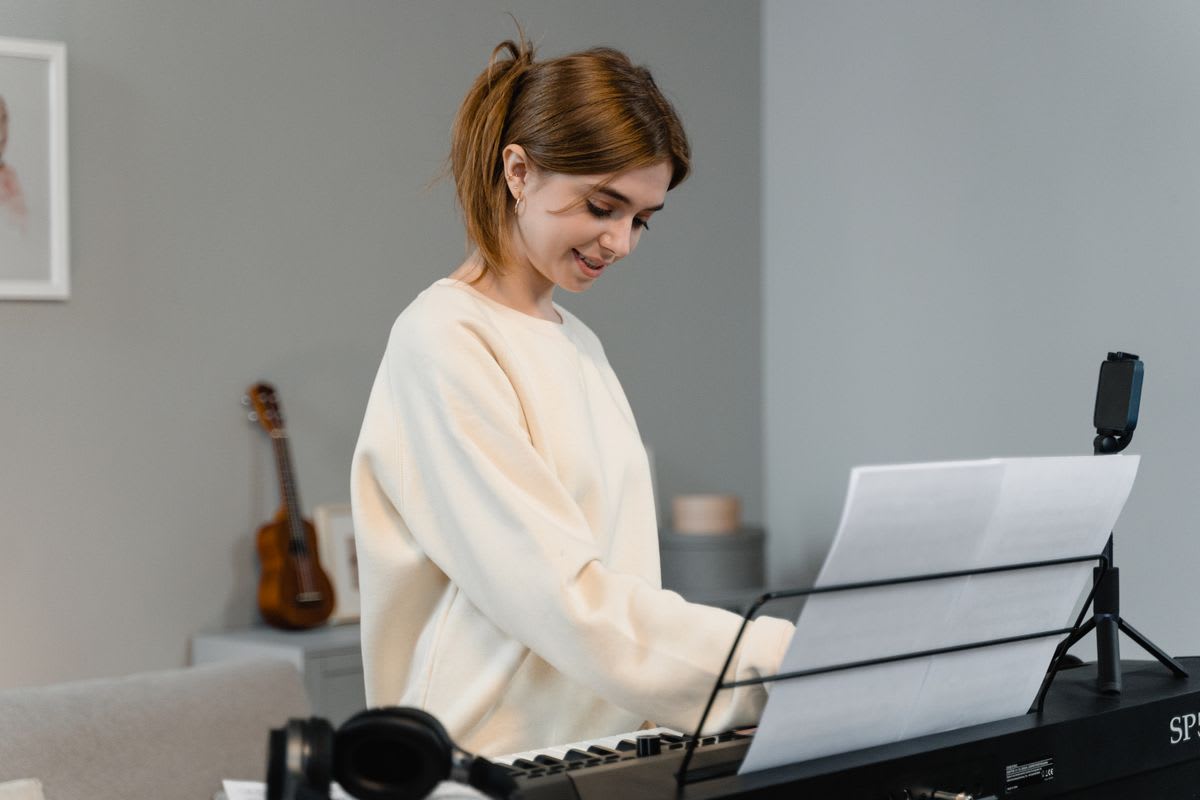
One more adult-specific advantage hides in plain sight: the lesson is recordable. Adults forget differently than children — not from inattention but from interference, because the lesson's insights compete with a week of meetings and logistics for the same memory. In-person students walk out with whatever survives the drive home. Online students can rewatch Thursday's explanation on Sunday, exactly when they need it, and the good ones build a habit around it: skim the recording once mid-week, note the two or three assignments in a practice log (ours is Practis, and this is precisely what it's for), and walk into the next lesson with the week documented instead of half-remembered. A monthly lesson plus that loop outperforms a weekly lesson without it — at a third of the price.
Where adults should start
Different adults, different doors. If you're brand new and want structure with zero social exposure, a teacher-led platform is the gentlest start. If you're returning after decades, or self-taught and suspicious something's wrong with your technique, go straight to a live teacher — our pick for serious adult 1-on-1 work is PianoTechSupport ($45/hour, Vienna-trained, trial lesson available), and the full field — including structured courses and kid-free adult-beginner options — is in the online piano teachers guide. And whichever door you pick, vet it like an adult buying a service, not a child assigned a teacher: nine questions will tell you in one trial lesson whether you've found the right person.
The honest caveats
Three, in fairness. Your setup matters — a badly aimed laptop genuinely degrades the lesson, and fixing it costs about $30 and ten minutes (the specifics are in the format comparison). Self-direction is load-bearing: the same autonomy that suits adults means nobody physically ensures you practise, so the week between lessons is entirely yours to win or lose — the research on adult music students is clear that self-direction is a skill beginners still need support with, so tell your teacher honestly if structure is what you need. And total beginners with a great local option lose little by starting in person for a few months; the argument here isn't that online always wins, it's that the format's reputation as the compromise is backwards for grown-ups.
"The studio lesson was designed around a child's needs. The video lesson, almost by accident, was designed around yours."
Common questions
Am I too old to start piano with online lessons?
No — and the evidence on this is genuinely comforting rather than politely encouraging. Adults learn piano at every age; what changes is the path, not the possibility. We've made the full honest case, with what to expect, in is it too late to learn an instrument at 40 — the short version is that motivation and consistency beat age every time they're measured.
How fast do adults actually progress?
Faster than the folklore says in the first year — adults out-learn children early because they understand structure, read instructions, and practise deliberately. The realistic arc: recognizable songs within weeks, genuinely enjoyable playing within a year, intermediate repertoire in two to three. The variable that dominates isn't age or talent; it's whether practice happened between the lessons.
Do adults need weekly lessons?
Not necessarily — and this is an adult privilege. Children need weekly contact because they can't yet self-correct or self-organize. A self-directed adult with a documented practice week often does beautifully on biweekly or monthly lessons, using the teacher as a correction layer rather than a metronome. Start weekly if you want momentum, then stretch the interval as your independence grows.
If you've been circling piano for years with "someday" attached, the format problem you were waiting to resolve has quietly resolved itself in your favor. The version of lessons that intimidated you — the studio, the waiting room, another adult watching you fumble scales — is no longer the default. The current default is your instrument, your living room, a teacher chosen from the whole world, and a rewind button. The remaining obstacle is the one it always was: booking the first hour. That one's yours.