

The skill that saves live performances is not perfect accuracy. It is re-entry. One wrong note usually does less damage than the freeze, grimace, tempo collapse, or random hunting that follows it. Most musicians practice the piece as if it will unfold cleanly from bar one to the end. Then a real slip happens and there is no trained route back into the music.
That is why "just keep going" is both correct and incomplete. Yes, continuity matters. But continuity only becomes usable when a player knows where to land, what can be simplified, and how to stop the first mistake from dragging the next two mistakes in behind it. Recovery is not luck. It is a trainable performance skill.
This post is about that skill specifically. Not how to prevent every error, and not how to judge yourself afterward, but how to get back into the piece while the piece is still happening.
The first mistake becomes dangerous when the pulse disappears
A missed note is often survivable. A lost pulse is where the real trouble starts. Catherine Wan and Gail Huon's study on performance degradation under pressure is useful here because it frames breakdown not simply as "nerves," but as an attentional problem. Under pressure, attention can get pulled toward task-irrelevant worry or toward over-controlling skills that normally run more fluidly. After a mistake, that attentional shift often becomes sharper: the player starts monitoring the error instead of carrying the line forward.
A broader 2024 Nature Communications paper found that people are often more error-prone immediately after committing an error. The exact task was not music performance, but the principle maps uncomfortably well onto what musicians recognize on stage. One slip creates a jolt. The body tightens, attention narrows, and the next response becomes more fragile than the one before it. That is why the "second mistake after the first mistake" is such a familiar performance experience.
The fastest protection against that cascade is not perfectionism. It is pulse preservation. If the beat keeps moving, the piece still has a track to run on. If the beat dies, every possible re-entry becomes harder because there is no longer a stable timeline to rejoin. This is also why so many musicians discover in public that they were never as performance-ready as they thought. The issue is not only whether the notes are learned. It is whether the piece can still move forward after a disruption, which is the larger transfer problem behind sounding fine in practice but falling apart in performance.
Recovery rule number one: the beat is usually worth protecting more than the exact next note.
Recovery starts from landmarks, not from random searching
When players get lost mid-piece, they often search for the "correct next note" as if recovery were a microscopic problem. In practice, recovery usually works better at a larger scale. Roger Chaffin and Gabriela Imreh's classic study Practicing Perfection showed that an expert pianist used performance cues as retrieval cues during performance. These cues were not just finger memories. They included structural and interpretive landmarks that helped organize recall.
Chaffin, Ginsborg, Dixon, and Demos make the point even more directly in their later work on recovery from memory failure. In that study, recovery points tended to occur at structural beats where the performer had a performance cue. Losses started where cues were weak; gains happened where cues existed. That finding is practical, not just academic. It means recovery is much easier when the piece contains known landing zones: phrase starts, harmonic arrivals, rhythmic resets, text entries, left-hand pattern returns, cadences, or any other checkpoint the performer can reliably recognize under pressure.
If the piece has no checkpoints, recovery becomes random hunting. If it has checkpoints, recovery becomes selection. That is a much calmer job. Instead of asking, "How do I get the exact missed material back?" the player can ask, "What is the next landmark I trust?" That question is also a strong readiness test. A piece is not truly performance-ready if it only works from the beginning and falls apart the moment you have to re-enter, which is why checkpoint work belongs in the broader test of whether a piece is ready to perform in public.
Live recovery triage
A mistake just happened
Pulse still alive
Stay in tempo and land on the next checkpoint.
Pulse wobbling
Simplify texture, keep the beat moving, and rejoin on the next strong beat or phrase start.
Memory blank
Skip ahead to the next trusted cue instead of searching note by note.
The job is not to erase the mistake. The job is to reconnect with the piece fast enough that the music can keep moving.
Simplify first, then rejoin the musical line
Many musicians panic because they think recovery means restoring the full original texture immediately. In live playing, that is often the wrong priority. If the accompaniment pattern, inner voice, or decorative figure is what got knocked loose, the better move may be to simplify temporarily and protect the musical spine. Singers can re-enter on the next text cue. Pianists can reduce texture and aim for the next harmonic arrival. Guitarists can land the chord and recover the pattern one beat later. String and wind players can privilege phrase direction and rhythmic placement over an exact ornamental detail. The exact tactic differs by instrument, but the hierarchy is similar: continuity first, detail restoration second.
This is consistent with the broader review Error management for musicians, which argues that musicians need strategies that balance risk, prevention, and adaptation instead of treating error as a catastrophic event. The paper is helpful because it also notes something performers know viscerally: musicians and audiences often perceive errors differently. A small slip that feels enormous on stage may register far less strongly in the hall, especially if the performer does not magnify it by stopping, grimacing, or draining the phrase of intention.
That does not mean "fake confidence" is the whole answer. It means recovery is often musical triage. If you cannot save everything, save the line. If you cannot save the line, save the pulse. If you cannot save the last detail, save the next reliable entry point. That order prevents the mistake from becoming an identity crisis in real time.
| If this is the problem | What panic usually does | Better recovery move |
|---|---|---|
| Wrong note, but pulse is intact | Replay it mentally and tense up | Ignore it and keep the bar moving |
| Pattern or fingering derailment | Try to restore every note immediately | Thin the texture and land on the next stable harmony or beat |
| Memory blank | Search locally note by note | Jump to the next trusted performance cue |
| Visible frustration after the slip | Broadcast the mistake to the room | Stay physically neutral and keep the phrase alive |
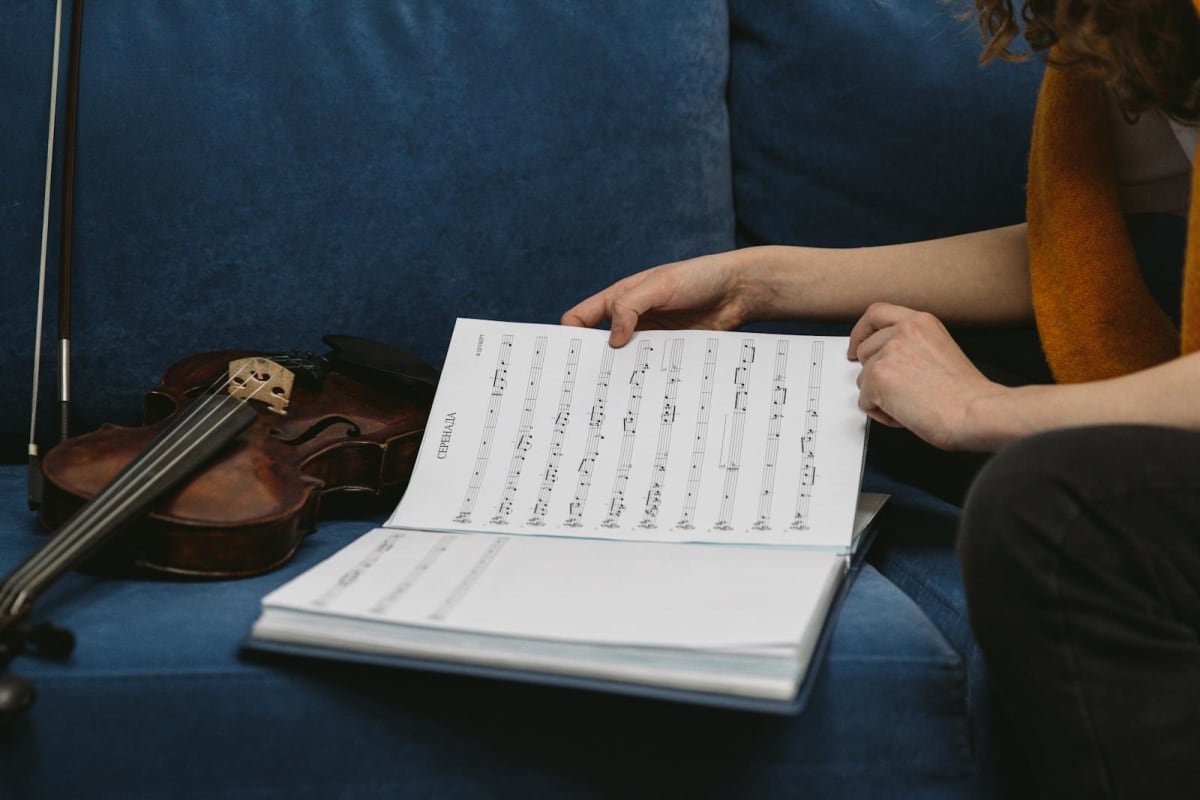
Photo: SHVETS production via Pexels
This is also why visible self-punishment on stage is so costly. In Noa Kageyama's article on why performers need a good poker face, the practical point is simple: reacting visibly to a mistake can change how the whole moment reads to listeners. Recovery is not only sonic. It is also behavioral. The calmer and smaller the reaction, the easier it is for the piece to keep its identity.
If you want recovery on stage, you have to practice recovery in practice
Many musicians rehearse only the ideal version of the piece. They stop whenever something goes wrong, fix the spot, and restart. That is useful for learning, but it trains very little live recovery. If every mistake in practice leads to a full stop, performance day becomes the first time you try to continue through disruption. Unsurprisingly, that makes the moment feel unfamiliar and dangerous.
Kageyama's piece on mistake rituals and on-stage surprises is valuable here because it leans on a broader performance principle: surprises reduce quality if the response itself has never been trained. For musicians, that means building recovery into ordinary preparation. Not every repetition should be ideal-path practice. Some should require continuing after a planted disruption, re-entering from a checkpoint, or finishing a section despite an intentional disturbance.
The drills do not need to be elaborate. They do need to be specific. Record one-take sections and forbid yourself from stopping. Start from random landmarks. Ask someone to interrupt your flow with a measure number or verbal cue so you have to land on the next checkpoint cleanly. Deliberately plant a wrong note and continue anyway. These drills pair well with recording yourself, because playback reveals whether the recovery actually kept the musical line intact or merely felt better from the inside.
Checkpoint starts
Start from phrase openings, cadences, lyric entries, or harmonic arrivals until those points feel like real places to land, not only to pass through.
Planted mistakes
Insert a deliberate wrong note or interruption, then practice staying in pulse and rejoining at the next cue instead of rewinding immediately.
One-take rule
Give sections where stopping is not allowed, so continuation becomes part of the trained skill instead of a performance-day improvisation.
Next-day repair
After the run, isolate the weak cue and fix it properly, which is where work like repairing a mistake you have reinforced many times becomes relevant.
The point of all this is not to normalize sloppy playing. It is to make the performance skill set more complete. A player who can recover gracefully is not less disciplined. They are better prepared for the reality that live music moves in one direction only.
What to do the moment the piece ends
When the piece is over, the recovery job changes. During the performance, the task was to keep the music alive. Afterward, the task is to capture what the episode taught you without turning it into self-attack. That usually means writing down where the first slip happened, what kind of slip it was, whether the pulse survived, and which landing point you used or wish you had used. Keep it factual. The goal is to build better cues, not a better shame spiral.
This matters because the real lesson is rarely "do not make mistakes." The better lesson is usually narrower: the checkpoint was weak, the transition was not actually secure, the memory only worked from the beginning, or the body tightened and killed the beat after the error. Those are trainable problems. They give you something to do next.
That is the quiet advantage of recovery work. It changes mistakes from proof of fragility into information about the piece's structure under pressure. And once you start training re-entry on purpose, one wrong note stops having the power to end the whole performance. It becomes what it usually was in the first place: one event in a piece that still knows where it is going.


