
Pianote Review 2026: The Teacher-Led App, Honestly Tested
Pianote is the teacher-led piano app — a structured course taught by real teachers, not a game or a solo instructor. Who it genuinely suits, where "teacher-led" stops short of a teacher, what it costs, and the honest verdict.
Pract.is Editorial
Research-based practice guidance for musicians from the Pract.is editorial team.

Pianote is the teacher-led piano app — a structured course taught by real human teachers, not a gamified solo course and not a private instructor. That one sentence is the key to judging it fairly. If you want the feeling of a proper course, led by professional teachers, with a clear path from zero and a community around you, Pianote is one of the best options in the category. If you want a teacher who watches your hands and fixes your technique in real time, Pianote — like every app — can't be that, and pretending otherwise is how people end up disappointed.
This review is based on Pianote's official membership and product pages, its published plan pricing, and the way its feature set compares with the rest of the field, checked in July 2026. For the broader category, see our guide to the best piano learning apps for adults; for the pure head-to-head against hiring a person, see Pianote vs. a private online teacher. Here we're judging Pianote on its own terms.
Pianote at a glance
9/10
for beginners who want structure taught by real teachers, not a game
6/10
as a substitute for a live teacher watching you play
8/10
for motivated adults who'll actually use the feedback and community
What Pianote actually is
Pianote is a membership platform built around a 10-level Method that takes a complete beginner through to advanced material in a deliberate sequence, taught on video by professional instructors — a roster that genuinely includes Grammy-winning and touring musicians. Around that spine sit the things that make it feel like a school rather than a worksheet: a library of 950+ popular songs with proper arrangements, guided play-along practice, an active student community (Pianote lists north of 100,000 members), and — the feature that most separates it from algorithm-led apps — personalized feedback from real teachers on videos you submit of your own playing. Because it runs on the wider Musora platform, a membership also bundles lessons for guitar, drums, and singing, which is a genuine bonus for a musical household.
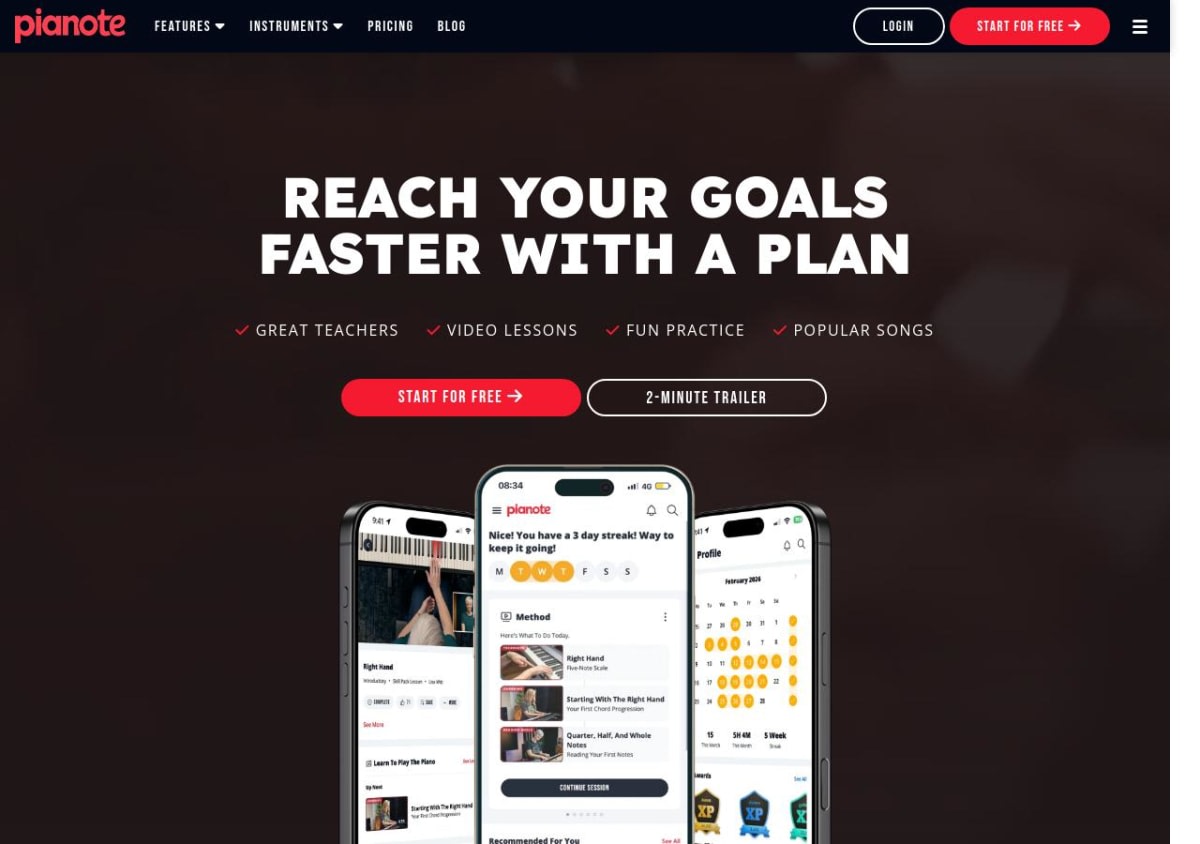
The important thing to hold onto is that all of this is content and structure at scale — excellent content, but the same content for every member. Your own playing only enters the loop when you choose to record and submit it, and the feedback comes back afterwards rather than while your hands are on the keys. That design is exactly what makes the price possible, and it's also the source of the app's one real limitation. We'll come to it.
Where Pianote is genuinely strong
Start with what it does better than almost anyone. The production and teaching quality is the best in the category — these are real educators who can explain why, not just show you which key to press, and it shows in how concepts are sequenced and demonstrated. The structure without scheduling matters more than it sounds for busy adults: a clear path you can walk at 6am or midnight, with no appointment to keep and no reschedule guilt. For a learner who mainly needs a route and momentum, that combination is hard to beat.
Two more strengths are easy to undervalue. The community gives the solitary act of learning piano a social dimension — accountability, encouragement, other adults at the same stage — that a solo app simply doesn't have, and for many people that's the difference between quitting in month three and still playing in year two. And the 90-day money-back guarantee, paired with a free first week, makes Pianote one of the lowest-risk ways to find out whether a structured, teacher-led course is actually how you learn. You can genuinely test it before committing.
"Pianote is the teacher-led app — a real course taught by real people. Just remember that teacher-led isn't the same as a teacher watching your hands."
Where it falls short
The core limitation follows directly from the design: teacher-led is not the same as a teacher watching you. Pianote's instructors are excellent, but they cannot see the collapsing wrist you don't know you have, because the feedback loop is submission-based and delayed. You record a video, and useful notes come back days later — genuinely valuable, and more than most platforms offer, but by then you may have repeated the error a hundred more times. For building repertoire and understanding, that latency barely matters; for changing ingrained physical technique, it's the whole ballgame, and it's why we're honest in the private-teacher comparison that a plateau or a technical fault is where a real teacher pulls ahead.
The second caveat is the same one that applies to every song-rich platform: the library invites song-hopping. Because there's always another appealing piece one click away, it's easy to sample twenty songs and finish none, which feels productive and isn't. The discipline of choosing one main piece and seeing it through is on you, not the app. And third, the price is real: Pianote costs meaningfully more than a pure gamified app, which is fair given the human teaching behind it, but it means the value depends on actually using the parts — the Method, the feedback, the community — that justify the premium. A member who only opens it to play songs is overpaying for a course they're not taking.
| Feature | Why it helps | What to watch |
|---|---|---|
| 10-level Method | A real path from zero, self-paced | Self-paced means self-discipline |
| Real teachers on video | Human explanation of the why | They can\u2019t see you unless you submit |
| Video-submission feedback | Actual human eyes on your playing | Arrives days later, not live |
| 950+ songs | Motivation; applies your skills | Song-hopping leaves fragments |
| Community (100k+) | Accountability and belonging | Only helps if you engage |
| Guitar, drums, singing | Whole household covered | Only valuable if you want them |
Pricing and plans
Pianote's pricing is membership-based, with a free first week and a 90-day money-back guarantee on top — an unusually generous safety net. At the time of writing (July 2026) it offers two tiers, both including unlimited lessons, real-teacher access, the community, and the guitar/drums/singing lessons:
Pianote
$30/mo · or $279/yr
The full membership, including the 950+ song library.
Pianote Plus
$25/mo · or $229/yr
Lessons-focused; songs can be added separately.
Risk
First week free · 90-day money-back guarantee · no lifetime plan.
A note on the tiers, because they trip people up: the confusingly-named plans differ mainly on the song library, so decide by whether learning popular songs is central to your motivation. Prices vary by region and change over time, so confirm the current numbers on Pianote's own plan page before subscribing — and use that free first week during a real practice week, not a busy one, so you're testing the product rather than your calendar.
"The 90-day guarantee makes Pianote one of the lowest-risk ways to find out whether a structured, teacher-led course is how you actually learn."
Who should choose Pianote — and who shouldn't
Choose Pianote if you're a beginner or returning adult who wants the structure and warmth of a real course — clear sequencing, teachers who explain, a community to belong to — and you'll actually use the feedback and the Method rather than just browsing songs. It's an especially strong pick for the self-motivated learner who wants a human-taught path but can't or won't commit to scheduled private lessons, and the guarantee makes trying it nearly free of risk.
Choose something else if your needs point elsewhere. If you mainly want to learn songs from a guided score and care less about a full curriculum, a song-first app like the one in our Flowkey review may fit better and cost less. If you're stuck, in physical discomfort, or preparing for an exam or audition, no app substitutes for a live teacher — the case we lay out in the 2026 map of online piano lessons and, for finding one, the best online piano teachers. And many adults land on the quiet best answer: Pianote for daily structure plus an occasional live lesson for the technique it can't see — provided you keep enough of a record of your practice, in a notebook or a tracker like Practis, to make those lessons count.
Choose Pianote if this sounds like you
Structure-seeker
You want a real curriculum, not a pile of loose tutorials.
Human-taught, self-paced
You want teachers who explain, without scheduled lessons.
Community learner
Accountability and other adults keep you coming back.
The verdict
Pianote is the best version of what it is: a structured, teacher-led piano course with genuine warmth, strong production, a real community, and a safety net that makes it easy to try. For a motivated beginner or returning adult who wants to be taught rather than gamified, it's one of the finest picks in the category, and the 8-to-9-out-of-ten scores at the top reflect that. Its ceiling is the honest one every app shares: it is teacher-led, not teacher-watched, so it can't fix in real time the physical habits that eventually cap self-taught players — which is a reason to pair it with occasional live feedback, not a reason to avoid it.
The one-line recommendation: if you want a real course taught by real people and you'll use the guarantee to test it properly, Pianote is well worth the money — just go in knowing it's the excellent teaching around your playing, not a teacher watching it, and plan the rest of your learning accordingly.
Common questions
Is Pianote worth it in 2026?
For its actual job — a structured course taught by real teachers, with a community and multi-instrument access — yes, it's one of the strongest options, and the 90-day guarantee removes most of the risk of finding out. It disappoints only when bought for the wrong job: as a replacement for live technique correction, which no content platform can be. Judge it as a brilliant school, not as a private teacher.
Is Pianote better than Flowkey or Simply Piano?
They aim at different learners. Pianote is the teacher-led, curriculum-and-community option; Flowkey is song-first guided sheet music; Simply Piano leans more gamified. If you want to be taught a real course by humans, Pianote leads. If you mainly want to learn songs cheaply, a song-app may fit better. Our apps roundup compares them directly.
Does Pianote's teacher feedback replace a real teacher?
It narrows the gap without closing it. Submitting a video for feedback gives you real human eyes on your playing — more than most platforms offer — but not the live loop of a lesson, where a teacher corrects you mid-phrase and watches you try again. For maintenance it's a fine substitute; for changing ingrained technique, the delay matters, which is why many players pair Pianote with an occasional live lesson.
Tested on its own terms, Pianote earns its reputation as the teacher-led app — and earns its price for the learner who uses what makes it different. Take the free week, submit a video, sit in the community, and walk one Method level. If that feels like being taught rather than gamed, you've found your platform. If you find yourself wishing someone could just watch your hands, that's not Pianote failing — it's the signal that your next step is a real teacher, with Pianote alongside it.
More on apps.

How We Test Music Apps: Our Review Methodology
A review is only as trustworthy as the process behind it. This is exactly how the Pract.is editorial team tests, scores, and keeps its music-app reviews honest — the method behind every verdict, in full.
Pract.is Editorial

Is a Piano Learning App Enough? The Evaluation Framework
"Is a piano app enough?" has no universal answer, because it's the wrong question. The right one is "enough for what?" — and it has a systematic answer. The framework for deciding when an app suffices and when it doesn't.
Pract.is Editorial
Skoove vs. Flowkey vs. a Real Teacher: The Adult Learner's Decision
Search "best online piano lessons for adults" and you get a wall of apps — but the real decision is between three genuinely different things: a guided course app, a song-first app, and a human teacher. Which job are you actually buying?
Pract.is Editorial