
Pianote vs. a Private Online Teacher: Which Should You Pay For?
At one lesson a month, a private teacher costs about what Pianote does — which makes this the real budget decision for adult learners in 2026. Two genuinely good products that do completely different things: here's the honest comparison, and the question that decides it.
Pract.is Editorial
Research-based practice guidance for musicians from the Pract.is editorial team.

Here's the budget arithmetic that makes this comparison worth an entire article: Pianote costs $25–30 a month, and a good private online teacher costs roughly $45 a lesson. At one lesson a month — a perfectly legitimate cadence for an adult learner — the two options cost nearly the same. Which means the real question isn't "which is cheaper?" It's the harder, better one: for the same money, do you want a world-class library with a community, or one hour of a trained ear on your playing specifically?
Both are genuinely good products. They are also almost completely different products, and most of the frustration in reviews of either comes from people who bought one expecting the other's strengths. So let's be precise about what each actually is, where each honestly wins, and the single question that settles which one deserves your card this year.
What Pianote actually is
Pianote is the most polished teacher-led piano platform in the space, and its offer is substantial: a structured 10-level Method that takes you from nothing to advanced material, a library of 500+ officially licensed songs with professional transcriptions, guided play-along practice sessions so you're never wondering what to do today, and video instruction from a roster that genuinely includes Grammy-winning and touring musicians. Members can submit videos of their playing for personalized feedback from real teachers, there's an active student community, and the membership piggybacks on the Musora ecosystem — meaning drums, guitar, bass, and vocals lessons come along free, which matters for musical households. The risk terms are unusually generous: a 7-day free trial and a 90-day money-back guarantee.
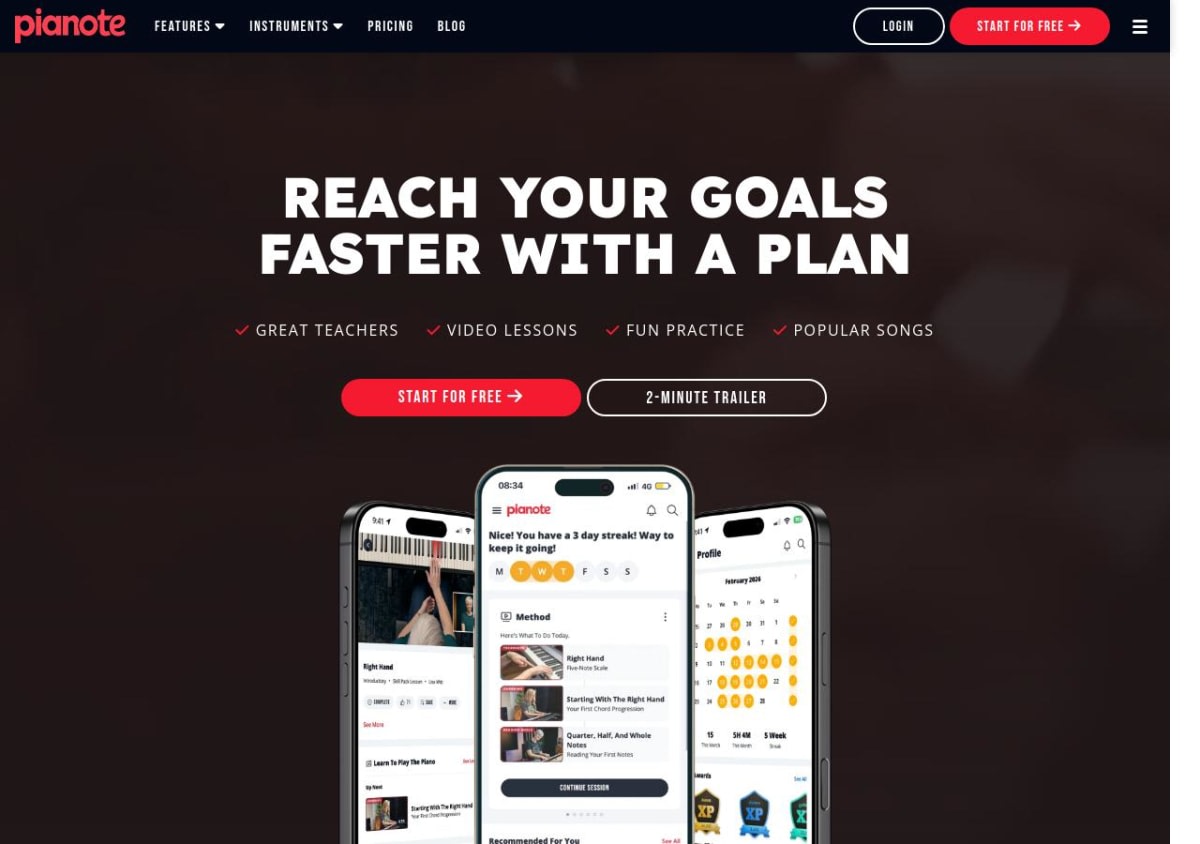
Notice what all of that is: content and structure, at scale. Superb content — but the same content for every member, with your personal playing entering the loop only when you choose to submit a video, and feedback arriving after the fact rather than while your hands are on the keys. That's not a criticism; it's the design, and it's what makes the price possible.
What a private teacher actually is
A private online teacher inverts every one of those properties. There is no library and no badge system — there is one trained musician watching you play, live, whose entire hour is spent on the specific things your hands and ears are doing wrong right now. The feedback loop is seconds, not days: you play, they stop you, you adjust, they confirm. The curriculum is whatever your playing needs next, the accountability is a standing appointment with a human who will notice, and the correction reaches things no pre-recorded video can — your wrist, your tension, your specific bar 17. Rates run $35–70 an hour for most online teachers (the full economics are in what online lessons cost in 2026), with credential-heavy outliers like PianoTechSupport — Vienna Music University M.A., our top pick among online piano teachers — at $45 with a trial lesson.
What the teacher doesn't give you is volume: no 500 songs, no daily play-along library, no community forum at 11pm. One concentrated hour, and then you're on your own with the assignments until next time. That's not a criticism either. It's the design.
Head to head
| Pianote | Private teacher | |
|---|---|---|
| Price | $25–30 / month | $35–70 per lesson |
| Who watches you play | Only videos you submit | A trained ear, live, every session |
| Feedback speed | Days (submission-based) | Seconds |
| Feedback specificity | Helpful, after the fact | Your exact hands, in the moment |
| Structure | 10-level Method, 500+ songs | Built around your playing |
| Accountability | Streaks, XP, community | A human expecting you |
| Breadth | Drums, guitar, bass, vocals included | Piano, deeply |
| Risk | 7-day trial, 90-day guarantee | Trial lesson, pay as you go |
The real difference: how fast your mistake meets a correction
Content teaches what to do. Only a live loop catches what you're actually doing.
Where Pianote honestly wins
For sheer learning material per dollar, nothing a private teacher offers competes: thirty dollars buys a month of unlimited method lessons, hundreds of licensed songs, and daily guided practice — content that would take years of paid lessons to walk through live. The structure without scheduling matters more than it sounds for busy adults: no appointments to keep, no reschedule messages, practice at 6am or midnight. The production quality is the best in the category, the community gives the hobby a social dimension solo lessons never have, the multi-instrument Musora access is a quiet family bargain, and the 90-day guarantee makes trying it nearly risk-free. For a motivated beginner who mostly needs a path and momentum, Pianote is arguably the best-value structured start in piano education right now.
"Thirty dollars a month buys more piano content than a teacher could deliver in years. What it can't buy is someone watching your hands."
Where a private teacher honestly wins
Everything personal. Technique is the unbridgeable gap: Pianote's teachers are excellent, but they cannot see the collapsing wrist you don't know you have, and submitted-video feedback — useful as it is — arrives days after you've repeated the error a hundred more times. Plateaus are the second gap: when your progress stalls, a library offers you more content, which is rarely the cure; a teacher diagnoses why you're stuck, which usually is. Accountability works differently too — streaks and XP motivate some people, but a standing appointment with a human who noticed you didn't practise is a different order of commitment device. And for anything with a deadline — exams, auditions, performances — there is no platform substitute for someone who knows what the panel listens for and prepares you for it.
The pattern is the one that runs through this whole category (we've mapped it fully in the 2026 lessons landscape): platforms scale content brilliantly and cannot scale attention. Teachers are made of attention and nothing else.
A month with each, side by side
Abstract comparisons hide texture, so picture the same month lived twice. With Pianote: you open the app most evenings for a guided 20–30 minute session — the Method tells you today's material, a play-along drills it, the streak counter ticks up. By week two you've moved a level and learned the verse of a song you actually like. In week three you record yourself for feedback and get thoughtful notes back a few days later: watch the left-hand balance, nice rhythm. It's pleasant, structured, and steady — and if a bad habit crept into your wrist in week one, it has now had thirty comfortable evenings to settle in, because nothing in the loop was positioned to catch it.
With a private teacher: the month starts with an hour that rearranges your priorities — the teacher hears your clip, spots that the "uneven run" is actually a fingering problem, assigns two bars of it slow, plus one piece section. You practise alone the rest of the month, some days well, some days aimlessly, with nobody there on the Tuesday you nearly skipped. At the next lesson the fingering fix has taken, the run is even, and you get the next redirect. Less volume, less fun on the average evening — and the one thing that was actually wrong with your playing is now actually fixed.
Multiply either month by twelve and you can see both futures: the Pianote year is broader — more songs, more theory, more momentum; the teacher year is straighter — fewer detours, habits corrected before they calcify. Which future you need depends entirely on what's currently in your way.
The question that decides it — and the combination
Strip everything above to one deciding question: does your current obstacle need someone watching you? If what's between you and better playing is material, structure, and motivation — you're new, or you're a self-steering hobbyist collecting songs — Pianote is the better purchase, and honestly a delightful one. If what's between you and better playing is your own playing — technique that feels wrong, a plateau that won't move, an exam approaching — no amount of content fixes that, and the teacher wins at any price in this range.
And because the two products don't overlap, the quietly optimal answer for many adults is both, staggered: Pianote as the daily engine ($25–30), plus a private lesson every month or so as the correction layer ($45) — about $75 a month total, which buys you the best of both designs and mirrors the hybrid path most successful adult learners end up running anyway. Start with whichever half addresses this season's obstacle, and add the other when its absence starts to show.
"One question decides it: does your current obstacle need someone watching you? Content can't fix what only attention can see."
Common questions
Is Pianote worth it in 2026?
For its actual job, yes — it's the strongest structured-content platform in the category, the teaching quality is real, and the 90-day guarantee removes most of the risk of finding out. It disappoints mainly when bought for the wrong job: as a substitute for live technique correction or as a plateau cure, which no content platform is. Judge it as a brilliant library with teachers, not as a teacher.
Doesn't Pianote's video feedback replace a teacher?
It narrows the gap without closing it. Submitted-video feedback gives you real human eyes on your playing — genuinely valuable, and more than most platforms offer. What it can't replicate is the live loop: the correction that arrives mid-phrase, the follow-up question, the immediate re-try under supervision. For maintenance it's a fine substitute; for changing ingrained technique, the latency matters.
What if I can only afford one — which first?
Complete beginner: Pianote first — your early obstacles are material and momentum, exactly what it's built for. Playing a year or more, or stuck, or preparing for anything: teacher first — a few well-spent hours will redirect months of practice, and you can always add the platform for daily structure later. Both offer trials; use them in that order.
This is one of the rare comparisons with no loser. Pianote is the best version of what it is; a good private teacher is the best version of something else entirely. Buy the one aimed at your actual obstacle, borrow the other's trial when curiosity strikes, and remember the arithmetic that started this: at one lesson a month, the price difference between these two philosophies of learning piano is roughly the cost of a pizza. Choose on design, not dollars.
More on lessons.

Trusted Online Piano Lesson Providers in 2026 (And How to Vet Them)
Every affiliate list calls every provider "trusted." Trust isn't a vibe — it's a short set of things you can actually check. The signals that separate a trustworthy online piano provider from a slick one, and a vetted shortlist by category.
Pract.is Editorial

A Week Between Piano Lessons: How Good Teachers Structure Your Practice
Piano practice between lessons works best when the teacher leaves you with a result, a method, and evidence to bring back. Here is what a well-structured week looks like, even when the week itself is messy.
Pract.is Editorial

Why Your Self-Taught Piano Progress Stalled (And What a Teacher Sees in 10 Minutes)
Self-taught piano progress often stalls when the player creating the problem is also the only person trying to diagnose it. Here is what a teacher can see in ten minutes, how they test the cause, and how to turn one correction into a better month of practice.
Pract.is Editorial