
Why Real Instruments Still Matter in an AI Music Era
Real instruments still matter because music is not just output. It is touch, timing, visible effort, feedback from the instrument, and the shared response of people in the room.
Pract.is Editorial
Research-based practice guidance for musicians from the Pract.is editorial team.

Real instruments matter more, not less, when synthetic music gets cheap. That is the part people keep missing. If AI can already flood streaming platforms with plausible music at industrial scale, then the scarce thing is no longer “audio that sounds like music.” The scarce thing is a body inside the loop: touch, pressure, timing, visible decision-making, and the unrepeatable adjustments that happen when a person is actually playing something.
That does not mean acoustic nostalgia wins and all technology loses. A synth, drum pad, electric guitar, or MIDI controller can still be a real instrument when a musician is physically negotiating it in time. The important distinction is not wooden versus digital. It is generated output versus performed interaction. Once you make that distinction, the case for real instruments becomes much clearer.
The context matters too. As of January 29, 2026, Deezer said it was receiving over 60,000 fully AI-generated tracks per day, around 39% of total daily deliveries. CISAC’s December 2024 study projected that creators in music face 24% of revenues at risk by 2028 from generative AI’s substitution effect. The abundance side of the story is real. But abundance changes what listeners start valuing. It does not erase value.
60,000 per day
Deezer says fully AI-generated uploads reached over 60,000 tracks a day in January 2026.
24% at risk
CISAC projects 24% of music creators’ revenues at risk of loss by 2028 from generative AI substitution.
More familiar
A 2025 PLOS One study found human-created music was perceived as more familiar than AI tracks in audiovisual tests.
Real instruments are feedback systems, not just sound generators
A prompt can ask for a mood. An instrument gives you resistance. That difference is bigger than it sounds. When a musician plays, they are not merely selecting notes from a menu. They are feeling key travel, string tension, bow resistance, breath pressure, stick rebound, pad response, and in many cases the physical vibration of the instrument itself. Those cues feed back into the next gesture.
That is why the haptics research matters here. In a 2023 review of vibrotactile musical interfaces, Stefano Papetti and colleagues write that touch has “pivotal importance” in musical expressivity and that vibrotactile feedback plays a significant role in shaping the perceived quality of digital musical instruments. That finding is useful because it cuts against a lazy version of this debate. The point is not “real means acoustic.” The point is that physical feedback matters, even on digital instruments, because musicians do not only hear what they play. They feel it.
That felt loop changes phrasing and control. It affects how long a note is leaned on, how a chord is weighted, how a bend is judged, how a drummer places a hit, how a singer adjusts breath pressure, and how a pianist times attack against resistance. Those are micro-decisions happening continuously, not one-time style settings. Generated music can imitate their result at the surface. It does not fully recreate the performer living inside the constraint system that produced them.

By “real instrument” here, think physically played system. That includes acoustic instruments, electric instruments, and electronic instruments that a performer is actually negotiating in real time.
Audiences hear bodies, not just audio files
A lot of discussion about AI music still assumes the ear works in isolation. In practice, audiences perceive performance as audiovisual and bodily. We do not only hear attack, timing, and dynamics. We also see motion, effort, commitment, hesitation, and shape. That visible layer changes what people think they are hearing.
The best compact evidence for that is Jonna Vuoskoski and colleagues’ study on crossmodal interactions in musical expressivity. They found that both auditory and visual kinematic cues significantly affect perceived expressivity in piano performance, with visual cues appearing somewhat stronger. That is a striking result. It means human musical presence is not decorative packaging around the “real” audio. It is part of the expressive signal itself.
Microtiming research points in the same general direction. Studies on groove and timing show that very small timing choices can change how listeners move, entrain, and experience pulse. The exact role of timing deviations is more nuanced than the old romantic claims about “human imperfection” suggest, but the larger point still stands: the feel of a performance is shaped by living timing choices, not only by correct note placement. That is one reason our earlier piece on what AI still gets wrong about music focused less on polish and more on phrasing, pacing, and hierarchy.
| Generated track | Physically played instrument | Why listeners notice |
|---|---|---|
| Sound is the product | Sound is the result of a visible action loop | People read intention from bodies as well as audio |
| No tactile negotiation at playback | Every phrase is shaped against resistance and feedback | The performance feels less generic and more authored |
| Timing is fixed once rendered | Timing can flex in response to room, touch, and momentum | The music can feel alive instead of merely correct |
| No performer presence for the audience to track | Gesture, risk, and effort remain legible | Expressivity is perceived more strongly |
That does not mean all live or instrumental playing is automatically better. Plenty of bad human performances exist. The point is narrower and more defensible: when a human really is playing, audiences are responding to more than the waveform. They are responding to embodied evidence.
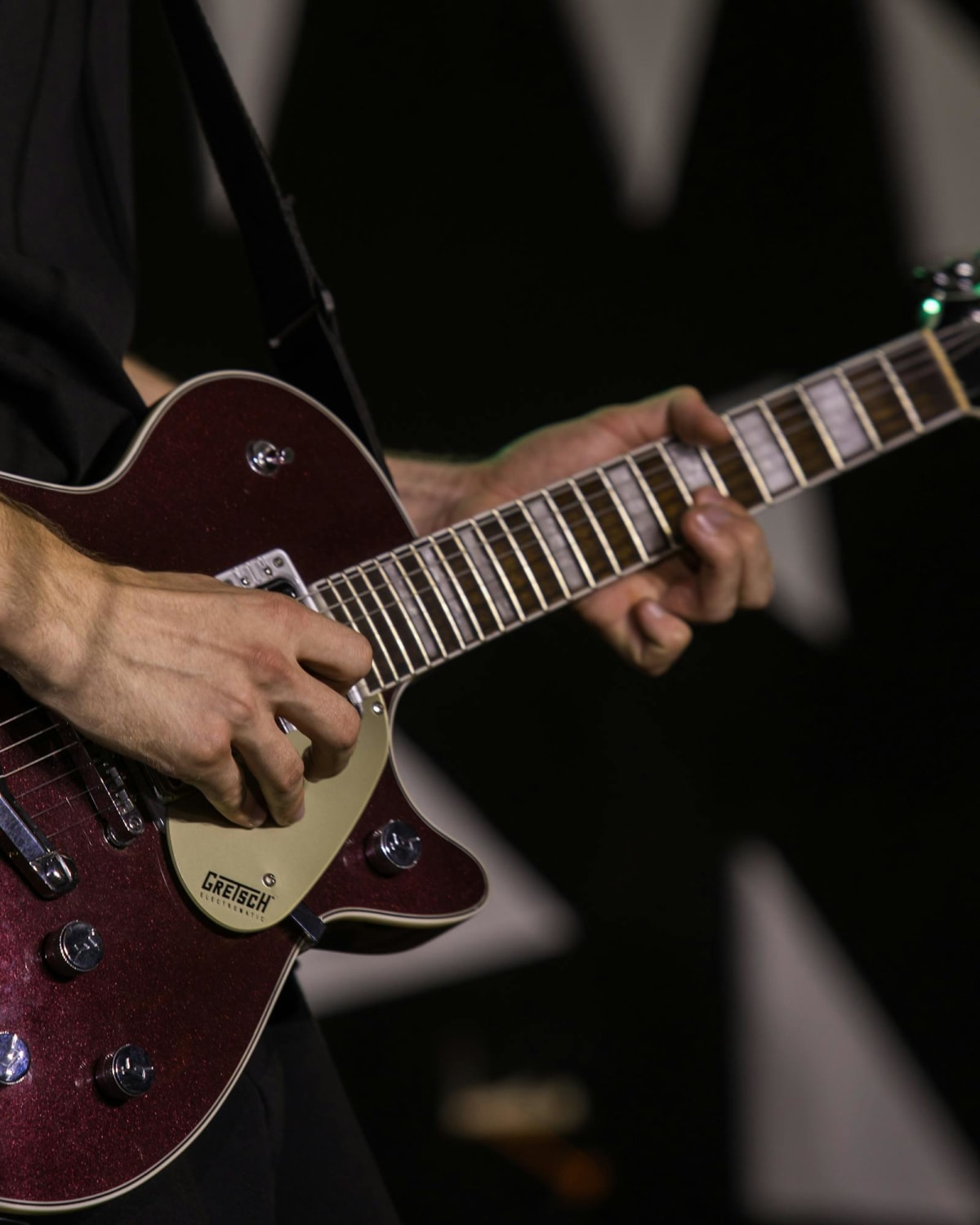
Photo: Biekir via Pexels
The room still changes the music
One reason real instruments still matter is that performance is not finished when the sound leaves the player. It keeps changing in the room. The audience responds. The performer senses that response, directly or indirectly, and adjusts. Tempo pressure shifts. Energy rises. A held breath changes the landing of a cadence. A groove either tightens or relaxes. This is not mystical. It is a practical loop between bodies in shared time.
Research on live music keeps finding evidence that this shared context matters. In How Live Music Moves Us, listeners at a live concert showed faster, more vigorous head movement than listeners hearing the same songs in an album-playback condition. The authors argue that live music likely increases arousal, anticipation, and connection with the performers. A 2023 Scientific Reports study on audience synchrony in live concerts likewise found above-random synchrony in audience physiology and body movement. That is not a romantic story about “energy.” It is measurable coordination.
This matters in an AI era because generated music can imitate style while bypassing situation. It can give you a finished-sounding object. It cannot fully substitute for a performer and audience co-regulating a moment in real time. Even when the notes are the same, liveness changes anticipation. The Frontiers study puts it plainly: during live performance, the music unfolds “in a unique and not predetermined way,” which increases involvement for listeners. That uniqueness is part of the product.
This is also why our post on where AI risk is real for working musicians drew a line between low-context music supply and higher-context human work. The more the value depends on adaptation, presence, and shared timing, the harder it is to flatten into interchangeable content.
What musicians should protect now
The practical takeaway is not “reject technology.” It is “protect the parts of your musicianship that become more valuable when generic audio becomes cheaper.” That means touch, timing, dynamics, responsiveness, arrangement judgment, and the visible confidence that comes from really knowing how to handle an instrument. It also means keeping the body in the training process, which is the same broader point we made in why music training ignores the body.
Protect
Touch-based control
Work on attack, release, resistance, and tone production, not just the notes that end up sounding correct.
Protect
Adaptation in time
Play with other people, record live takes, and practice reacting instead of only assembling polished fragments.
Protect
Visible musicianship
Let people see real playing when it serves the music. Audiences are reading effort, shape, and intent as part of the performance.
Real instruments still matter because music is not only information. It is friction, timing, bodily choice, and response. In a market crowded with plausible sound, those things do not become old-fashioned. They become easier to hear.
Bottom line
The future is not acoustic purity versus software. It is whether a body is still inside the musical loop strongly enough for listeners to feel it.
More on science.
AI × Music in 2026: The Living Guide to Suno, Udio, Copyright, and Licensing
AI music in 2026 is moving from open generation toward licensed systems. Here is the current Suno, Udio, copyright, and release-rights picture.
Pract.is Editorial

Why A=440 Hz Is the Standard (and the A=432 Hz Myth)
A=440 became the global standard for practical reasons: coordination, manufacturing, and broadcasting. A=432 is a valid preference, but the bigger healing claims do not hold up cleanly.
Pract.is Editorial

Why Gen Z Keeps Finding Classical Music Online
Gen Z is not stumbling into classical music by accident. Clips, study playlists, gaming scores, and internet-native creators have built a much easier path into the genre than classical institutions used to offer.
Pract.is Editorial