
AI × Music in 2026: The Living Guide to Suno, Udio, Copyright, and Licensing
AI music in 2026 is moving from open generation toward licensed systems. Here is the current Suno, Udio, copyright, and release-rights picture.
Pract.is Editorial
Research-based practice guidance for musicians from the Pract.is editorial team.

AI music in 2026 is no longer one argument. Suno is shipping a more capable model while preparing label-licensed systems; Udio is operating inside a no-download transition while building a licensed service; US copyright still turns on human authorship; and streaming platforms are adding disclosure and anti-spam rules. This guide separates those moving parts, because "AI music is legal now" and "AI music is banned" are both much too simple.
The 2026 picture in one screen
The useful way to read the market is as four separate stories: what the tools can do, what music their models are allowed to learn from, what parts of an output a person may own, and where that output can be released. A deal in one column does not automatically settle the others.
| Area | What is true now | What is still moving |
|---|---|---|
| Suno | v5.5 is live; paid subscribers receive commercial-use rights for songs made while subscribed. | New music-industry models are planned for later in 2026; non-Warner label litigation remains unresolved. |
| Udio | The current service remains available inside a closed system; audio, video, and stem downloads are disabled. | A licensed successor is being built with label and publisher partners; Sony filed a new copyright action in July. |
| US copyright | Human-authored expression can be protected even when AI assists the process. | Prompt-only output normally lacks enough human control; protection remains case by case. |
| Release platforms | Impersonation, spam, provenance, and disclosure are becoming the practical filters. | Credits and voluntary labels are spreading, but implementation is not yet uniform. |
"A platform can license training data without making every output copyrightable, exportable, or safe to release."
Licensed does not mean legally settled
The word licensed is doing too much work in AI-music coverage. It may describe permission to train a future model on a particular catalog. It may mean access to an artist's voice for an approved fan experience. It may cover a platform's use of compositions but not recordings, or recordings but not every songwriter's share. It does not mean that every label, publisher, performer, and territory has signed the same agreement.
When a company says "licensed," ask which one
Warner Music Group and Suno settled their litigation and announced a partnership in November 2025. The deal describes artist and songwriter opt-ins and new licensed models expected in 2026. Suno's March 2026 v5.5 announcement, however, says those industry models are still coming later in the year. In other words, the partnership is real; it is not a reason to relabel every current Suno generation as fully catalog-licensed.
Udio has gone further into a transition. Its agreements with Universal Music Group and Warner Music Group describe a new licensed service, while a June 2026 NMPA agreement creates an opt-in path for member publishers. Yet Sony's July 2026 case against Udio shows that one set of agreements does not erase every dispute.
For the deal-by-deal background, our post on what the Suno and Udio licensing deals mean for musicians goes deeper. The shorter rule is this: read a license as a named set of permissions, not as a halo around the entire product.
One AI song contains four separate rights questions
Think of an AI-assisted track like a studio session with four faders. Turning one up does not move the others. A clean commercial release needs all four set deliberately.
The four-fader rights check
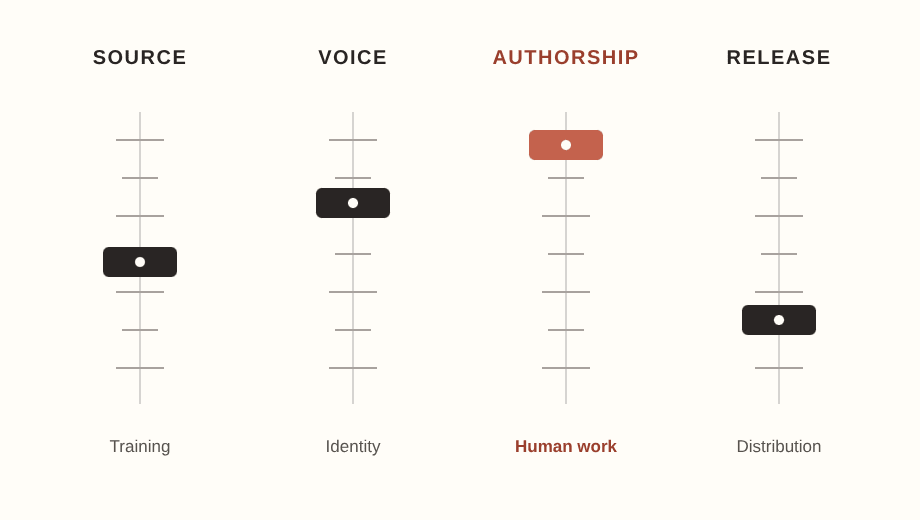
1. Source: what was the system trained on, and did the developer have permission? The US Copyright Office's AI reports do not declare all training fair use or all training infringement. Its 2025 training report says the analysis depends on the use, while warning that commercial systems built from huge stores of expressive work to produce competing content can exceed established fair-use boundaries, especially where access was unlawful. Courts still have to decide the live cases.
2. Voice and identity: did a recognizable person consent to the imitation? Copyright is not the only right in the room. A voice clone can raise publicity, privacy, unfair-competition, contract, and platform-policy questions even when no melody was copied. Suno's verified Voices and the planned artist opt-ins from Suno and Udio point toward the durable model: identity used by permission, with control and payment. Asking for "a famous living singer without naming them" is not a clever substitute for consent.
3. Authorship: which expressive choices did a human actually make? The Copyright Office's copyrightability report says AI assistance does not disqualify a work, but purely AI-generated material is not protected in the United States. Prompts alone generally do not supply enough control. A musician may still own a human-written lyric, melody, performance, arrangement, edit, or creative selection of generated material, but the claim covers that contribution rather than magically absorbing the machine-made parts.
4. Release: do the tool's terms give you commercial use, and will your distributor, label, publisher, client, or streaming service accept the track? Suno says songs made while a user is on a paid plan receive commercial-use rights, but its own rights guidance correctly separates those contractual rights from copyright protection. Udio currently blocks audio, video, and stem downloads during its transition, so a polished result inside the service is not presently the same thing as an exportable release master.
This is a US-centered explanation, not legal advice; copyright and personality rights differ by country. For a commercial campaign, a label release, a sync placement, or a convincing voice replica, ask a qualified lawyer about the actual project rather than relying on a general guide.
What Suno and Udio actually let you do today
The home pages look similar: type an idea, get a song. The current products are less alike once the result exists.


| Question | Suno | Udio |
|---|---|---|
| Current product | v5.5, with Voices, Custom Models, and taste controls | Existing beta operating during a licensed-platform transition |
| Download today | Yes; plan and usage terms apply | No audio, video, or stem downloads |
| Commercial use | Granted for tracks created while subscribed to a paid plan | Not a practical release route while exports are disabled |
| Licensed future service | Warner partnership; new industry models planned later in 2026 | UMG, WMG, publisher, Kobalt, and Merlin agreements announced |
| Legal status | Warner settled; other label claims remain pending | UMG and WMG settled; Sony filed a new action in July 2026 |
Suno is the more usable choice if the immediate goal is to generate, download, and distribute a track under the platform's current paid-plan terms. That does not settle copyright or every upstream training claim. Udio is better understood as a preview workspace during reconstruction: its own transition notice says downloads are unavailable while it builds the licensed experience. That may become a compelling artist-approved product, but it is not the same workflow it offered before October 2025.
Neither should be mistaken for a musician in a box. Our post on what fast AI songs still get wrong about music covers the musical weaknesses behind the impressive first impression: long-range form, intentional performance, meaningful revision, and the ability to know why one choice belongs. Those are also the areas where human work makes an output more artistically distinct and easier to document as authorship.
Release platforms care about provenance, impersonation, and volume
The next phase of AI-music policy is less likely to be a simple yes-or-no ban than a sorting system. Platforms want to know whether a track impersonates someone, whether it is part of a spam operation, whether the rights trail is credible, and whether the sender can identify how AI was used.

Those numbers need their source labels. Deezer reports that fully AI-generated tracks reached roughly 75,000 daily uploads, or 44 percent of new music, in April 2026. Yet they accounted for only 1 to 3 percent of streams, and Deezer classified most of those streams as fraudulent. The company tags fully AI music, removes it from recommendations, and demonetizes detected fraud. That is not an audience triumph; it is a supply-and-spam story.
Spotify's policy direction targets unauthorized vocal impersonation and mass-upload spam while accepting standardized AI-use credits from distributors. Its credit system can distinguish AI involvement in vocals, instrumentation, lyrics, and other production areas. An absent credit does not prove a track is human-made, because the system depends on submitted metadata, but the direction is clear: provenance is becoming part of release plumbing.
In July 2026, music organizations also introduced voluntary sound-recording labels for AI-Generated and AI-Assisted work. The distinction matters. A fully generated recording and a human performance cleaned with an AI restoration tool should not carry the same label. We examined the listener side in our post about AI-generated songs reaching the charts; the durable concern is not that listeners will accept nothing involving AI, but that industrial-scale output can swamp discovery before anyone knows what they are hearing.
"The strongest AI-assisted release is not the one that hides the machine. It is the one that can show what the musician actually contributed."
A release workflow that survives the rules changing
No checklist can eliminate legal uncertainty, but a disciplined project file travels better than a vague memory of how a song was made. The following workflow is useful whether the final track contains five percent AI or ninety-five.
Before an AI-assisted track leaves the studio
This may sound less exciting than generating a finished chorus in thirty seconds. It is also the part that turns an experiment into a defensible release. The musician who can produce a session file, a lyric history, a clean identity permission, and a dated copy of the relevant terms is in a much stronger position than the person whose entire provenance is "I typed a prompt and downloaded what came back."
The job question is similarly specific. AI is already useful for mockups, functional background music, rapid variations, and low-budget content, while live performance, trusted collaboration, artist identity, and high-context teaching remain much harder to substitute. Our post on where AI poses a real risk to working musicians separates those markets instead of pretending every music job faces the same pressure.
Three developments will change this guide next: the public launch and actual terms of Suno's and Udio's licensed models; court decisions that move training disputes beyond complaints and settlements; and wider adoption of AI-use credits by labels, distributors, and streaming services. Until then, the safest reading is neither panic nor permission. Treat AI as a production tool with a moving rights stack, keep the human work visible, and check every fader before release.
More on science.

Why A=440 Hz Is the Standard (and the A=432 Hz Myth)
A=440 became the global standard for practical reasons: coordination, manufacturing, and broadcasting. A=432 is a valid preference, but the bigger healing claims do not hold up cleanly.
Pract.is Editorial

Why Real Instruments Still Matter in an AI Music Era
Real instruments still matter because music is not just output. It is touch, timing, visible effort, feedback from the instrument, and the shared response of people in the room.
Pract.is Editorial

Why Gen Z Keeps Finding Classical Music Online
Gen Z is not stumbling into classical music by accident. Clips, study playlists, gaming scores, and internet-native creators have built a much easier path into the genre than classical institutions used to offer.
Pract.is Editorial