
Why “Relaxing Piano” Playlists Often Feel Empty
A lot of relaxing piano on streaming now feels emotionally thin because it is built to be useful first: smooth, non-disruptive, and playlist-compatible before it is memorable.
Pract.is Editorial
Research-based practice guidance for musicians from the Pract.is editorial team.

A lot of “relaxing piano” is not trying to move you. It is trying not to interrupt you. That distinction explains most of the emptiness people feel without always being able to name it. The track may be pleasant. It may even be beautifully recorded. But it often feels emotionally thin because the job is no longer “say something in piano language.” The job is “stay on in the background without causing friction.”
That is not the same thing as bad music. It is a different design target. Once a piece is optimized for sleep, focus, studying, or soft ambient company first, a lot of the musical traits that make piano playing feel specific start getting shaved down. Contrast drops. Rubato narrows. Harmonic choices stay safer. The track becomes less likely to pull you out of your task, and also less likely to stay with you when the task is over.
This is also a different argument from our piece on piano ASMR on YouTube. That post was about format and platform aesthetics. This one is about streaming playlists, background-listening economics, and why “calm” can so easily turn into “blank.” It also overlaps with why playing accurately is not the same as playing musically, because technically smooth piano can still feel emotionally underdrawn. Both things are true at once.
The first job of these playlists is not art. It is utility.
If you want to understand why so much relaxing piano feels interchangeable, start with function. These playlists are not mainly sold as recital listening. They are sold as tools for sleep, concentration, decompression, studying, and regulating the room. That changes what wins.
Research on background music does not point to one perfect formula, but it does give some clues about why lyric-free, smoother music is favored. In Background music: effects on attention performance, music with lyrics had a significantly worse effect on concentration than lyric-free music. Other open-access work like Studying the effect of self-selected background music on reading task shows that background music interacts with task demands and personal preference in more complicated ways than the generic “music helps you focus” line suggests.
The practical takeaway is simple: if a platform wants the safest broad-use “focus” track, it is likely to prefer music that stays instrumental, predictable enough, and low-friction enough to avoid competing with the listener’s main activity. That does not automatically produce bad music. But it does tilt the field toward tracks that are less demanding, less contrast-heavy, and less interpretively idiosyncratic.
Playlist goal
Do not distract
Smooth tempo, lyric-free texture, and moderate harmonic familiarity are safer than anything spiky or narratively dramatic.
Musical cost
Less contour
When the track must avoid interruption, it often avoids strong turns of phrase, timing risks, and sharp emotional pivots too.
Listening result
Calm but forgettable
The piece serves the room successfully while leaving very little behind as a musical memory.
That is why “empty” is often the wrong first word but the right final feeling. The tracks are not empty of sound. They are empty of urgency. You can hear the usefulness immediately. You cannot always hear why this exact pianist, this exact phrase shape, or this exact harmonic turn had to exist.
Playlist systems flatten context until everything feels like the same blanket
Even good music can start to feel generic when it is shoved into a narrow utility frame. Pitchfork’s 2022 feature Inside the Ambient Music Streaming Boom makes this point especially well. The problem, Andy Cush argues, is often not the music itself but its decontextualization: tracks by very different artists end up presented as identical warm blankets for sleeping, focusing, or caring for houseplants.
That flattening matters for piano in particular, because piano interpretation is intensely sensitive to context. A tiny hesitation before a cadence, a drier attack, a longer pedal cloud, a sharper internal accent: these are the details that turn “pleasant piano” into a voice. Once tracks are consumed mainly as category fillers inside “Peaceful Piano”-type listening, those differences stop being the main point. The playlist promise becomes the identity. The musician becomes secondary.
| Calming piano with a point of view | Playlist-fit relaxing piano |
|---|---|
| You remember something specific about touch, pacing, or atmosphere afterward | You mostly remember that it did not bother you |
| The phrasing feels shaped by a person | The phrasing feels standardized for function |
| Dynamics and timing create some tension and release | Everything stays politely level so the track blends |
| You could imagine following the artist further | You are meant to stay inside the playlist mood instead |
This is also why background playlists can be both useful and artistically flattening at the same time. They absolutely help some listeners find music, and they absolutely help some artists earn money. But they also train the ear toward function-first listening. Once the frame becomes “give me more of the same softness,” musical distinctions get compressed.
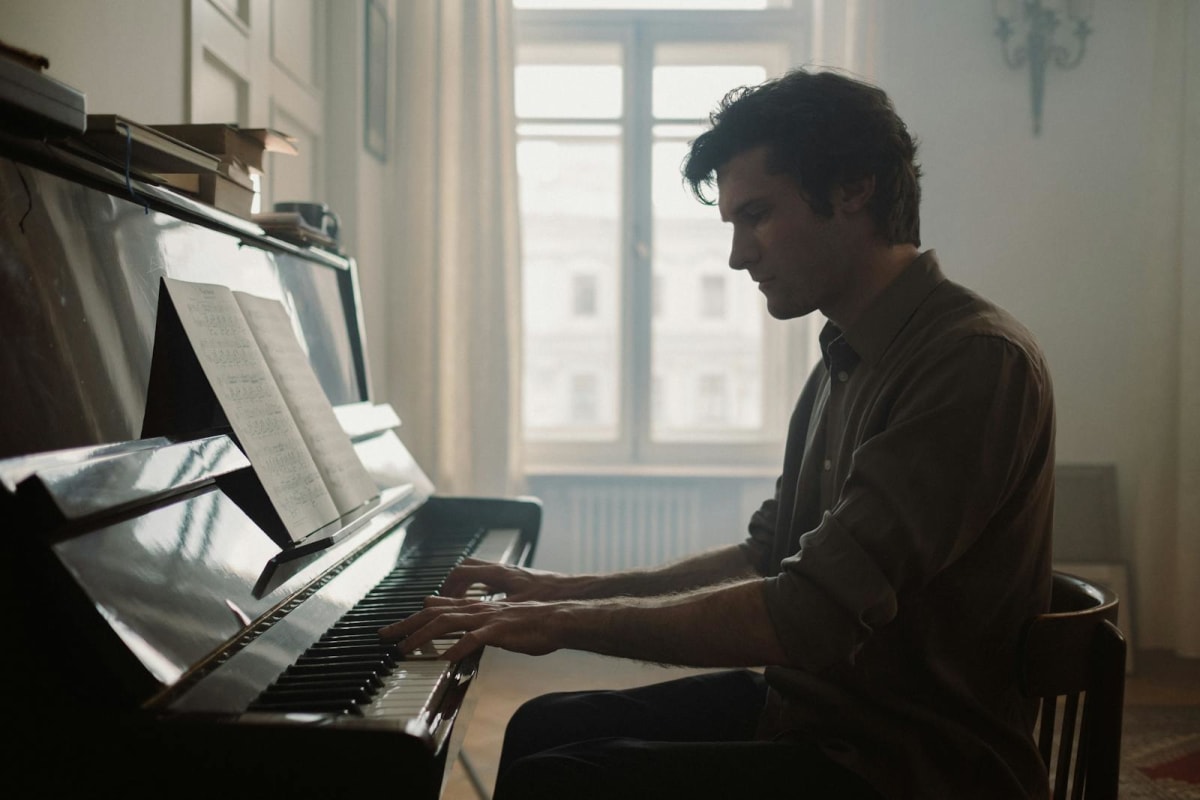
Photo: cottonbro studio via Pexels
The economics reward music that is easy to leave on
The emptiness is not just aesthetic. It is economic. Playlist environments reward tracks that fit the mood lane quickly, survive low-attention listening, and can be multiplied at scale. That is part of why the “ghost artist” debate matters here even if the exact details vary by platform and source.
Terrence O’Brien’s 2025 Verge essay The algorithm failed music describes the system bluntly: recommendation engines are built to keep you listening, not necessarily to deepen musical discovery. In that environment, the safest content is often the most useful to the platform. Pitchfork’s ambient-playlist feature reports the same pattern from another angle, noting playlists filled with pseudonymous or near-anonymous artists whose tracks seem “almost taunting in their refusal to do anything interesting.”
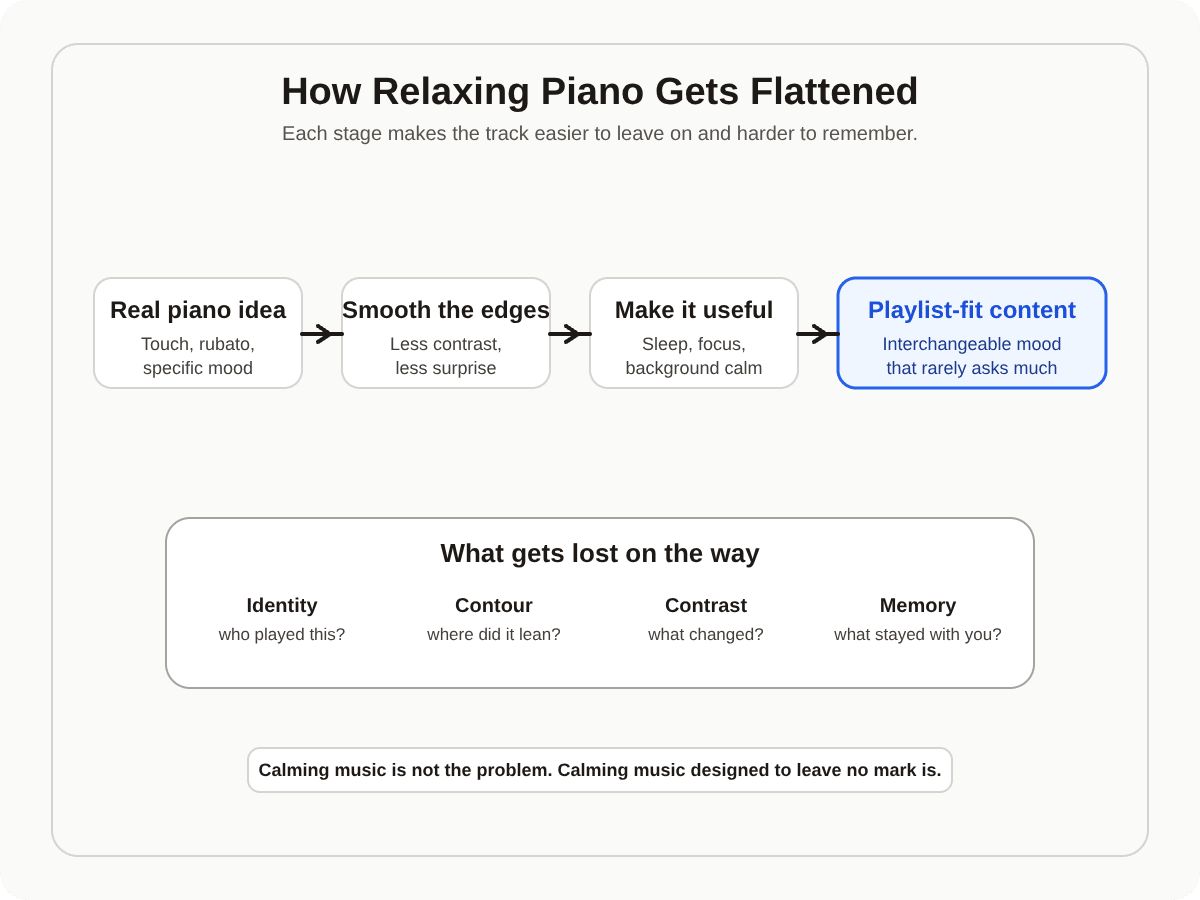
The result is not that every peaceful piano playlist is fake or cynical. It is that the system selects for traits that make tracks interchangeable more easily than it selects for traits that make them unforgettable. If a piece is calm, unintrusive, and polished enough to disappear into the room, it already satisfies the brief. The pressure to go further is weaker.
Playlist-factory music is not defined by being calm. It is defined by being engineered so that almost any equivalent track could replace it without the listener caring much.
That is also why the relaxing-piano world overlaps with the broader culture of content filler. Our AI-song piece makes a similar point from the composition side: surface plausibility is easier than deeper musical intent. With relaxing playlists, the surface often wins because surface is enough to meet the product goal.
Calm is not the same as emotionally thin
It would be a mistake to conclude that relaxing music is shallow by definition. Some of the most moving piano music ever written is quiet, slow, and low-volume. Satie, late Brahms, parts of Feldman, the softer edges of Debussy, plenty of contemporary ambient piano records: calm music can be emotionally thick. It can carry ambiguity, grief, tenderness, suspension, or even dread while remaining gentle on the surface.
That is why “empty” and “relaxing” should not be treated as synonyms. The difference usually sits in what the track risks. Does it allow asymmetry? Does it make one phrase matter more than another? Does it let the player’s timing, voicing, and touch become identifiable? Does it ask the listener for even a little emotional adjustment, or is it engineered to smooth everything into the same pleasant haze?
Calm with depth
You can feel decisions in touch, timing, and contour even though the piece stays gentle.
Calm without depth
The music stays sonically pleasant by refusing almost every sharper choice that might give it identity.
Why it matters
One kind of music relaxes you and remains a piece. The other relaxes you by becoming replaceable.
This is also where the “favorite music” finding matters. In Emotional responses to favorite and relaxing music predict music-induced hypoalgesia, the authors show that relaxing music can have real physiological value, but favorite music still carries a stronger personal-emotional charge. That is the gap. Relaxation alone is not the issue. The issue is when the music is designed to be relaxing for anyone and specific to no one.
That is why so many relaxing piano playlists feel empty. They are often built to succeed as environment before they succeed as music. The closer a track gets to perfect background function, the easier it becomes to leave on, and the harder it becomes to love.
More on science.
AI × Music in 2026: The Living Guide to Suno, Udio, Copyright, and Licensing
AI music in 2026 is moving from open generation toward licensed systems. Here is the current Suno, Udio, copyright, and release-rights picture.
Pract.is Editorial

Why A=440 Hz Is the Standard (and the A=432 Hz Myth)
A=440 became the global standard for practical reasons: coordination, manufacturing, and broadcasting. A=432 is a valid preference, but the bigger healing claims do not hold up cleanly.
Pract.is Editorial

Why Real Instruments Still Matter in an AI Music Era
Real instruments still matter because music is not just output. It is touch, timing, visible effort, feedback from the instrument, and the shared response of people in the room.
Pract.is Editorial