
The Rise of "Piano ASMR" on YouTube — Art or Content Factory?
Close-up piano videos now live in three different economies at once: intimate performance, functional background listening, and industrial filler. This piece argues that the label “piano ASMR” is now hiding all three.
Pract.is Editorial
Research-based practice guidance for musicians from the Pract.is editorial team.
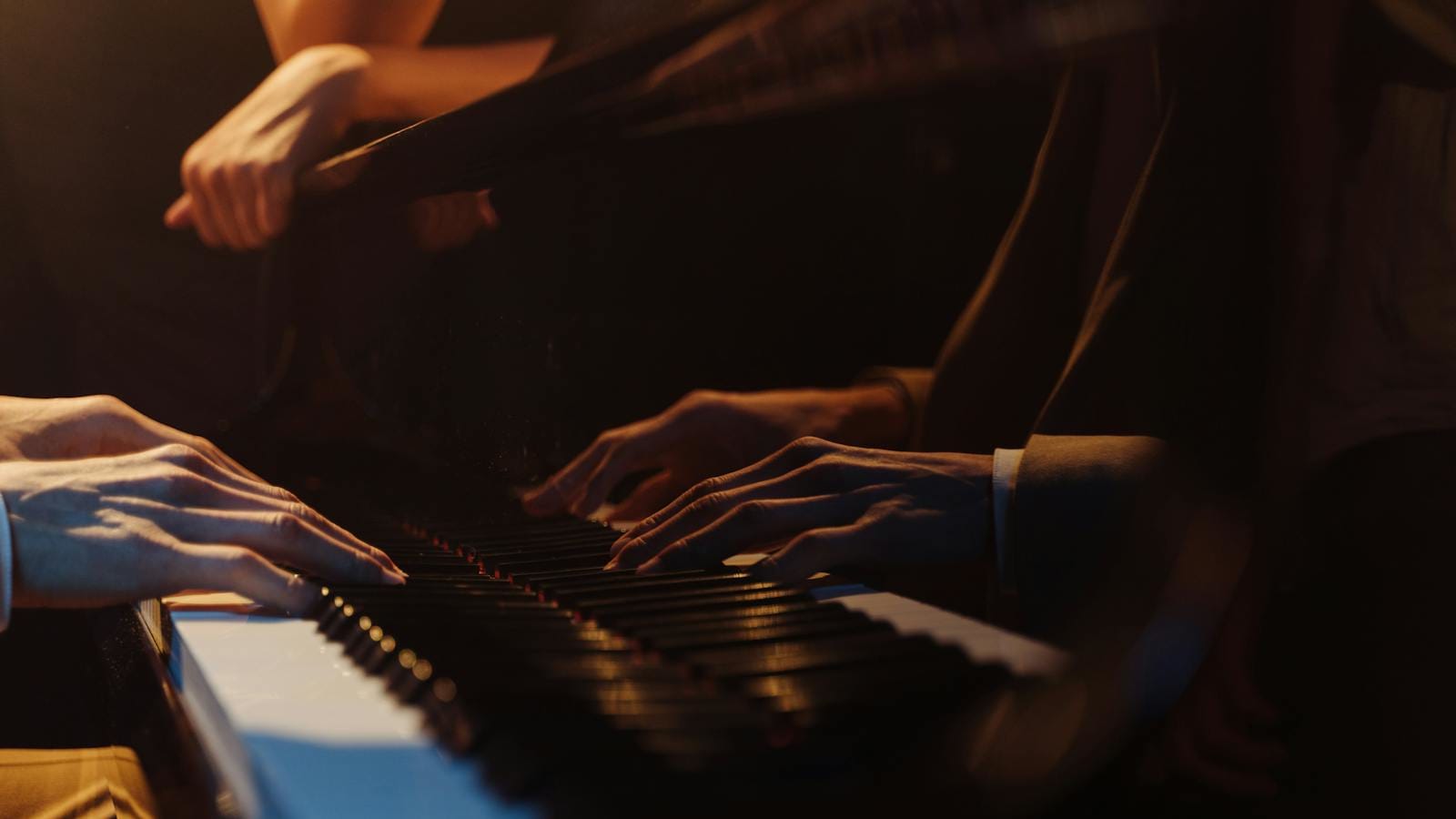
The problem with “piano ASMR” is not that it exists. The problem is that the same label now covers three very different things. Sometimes it means intimate, beautifully recorded piano playing that happens to borrow ASMR aesthetics: close framing, soft dynamics, careful mic placement, visible hand movement, quiet room sound. Sometimes it means functional listening: music for sleep, study, stress relief, or background calm. And sometimes it means the full content-factory version, where the point is not the pianist, the interpretation, or even the piece. The point is to keep a slot in the algorithm warm.
Those three categories can look almost identical in a thumbnail. Hands over keys. Candlelight or rain. A promise of calm. Maybe a title about sleep, focus, or peace. But culturally they are not the same object at all. One is still music. One is mostly utility. One is basically packaging.
My view is that the rise of piano ASMR on YouTube is both real and understandable. YouTube’s own Culture & Trends team said there were more than 32 billion views related to oddly satisfying videos in the U.S. alone through September 23, 2023. And in October 2025, YouTube said it had over 2 billion logged-in viewers watching music videos each month, while paying out over $8 billion to the music industry across the preceding twelve months. That is a huge machine. If soft, visually pleasing piano content helps people relax and keeps them on-platform, of course the format multiplies.
32B views
YouTube says oddly satisfying videos crossed 32 billion U.S. views in 2023.
2B music viewers
YouTube says more than 2 billion logged-in viewers watch music every month.
$8B paid out
The platform is economically large enough to pull more and more creators into mood-format music.
Why piano fits ASMR on camera almost too well
Piano has a built-in ASMR advantage. The instrument is percussive enough to generate tiny tactile details, but soft enough to stay comforting when recorded closely. Key travel is visible. Finger contact is visible. Pedal timing is visible. The listener can watch cause and effect at a microscopic level: this finger lands, this hammer fires, this overtone blooms. Even before you get to repertoire, the medium is already doing a lot of work.
That overlaps strongly with what ASMR research has been observing for years. In the 2022 CHI paper Close-up and Whispering, the authors analyzed 2,663 YouTube ASMR videos and described the format as producing three recurring experiences: multimodal social connection, relaxing physical intimacy, and sensory-rich activity observation. Piano slots neatly into that third category and often into the first two as well. The hands are doing something skillful and legible. The camera feels near. The audio feels private.
The older physiology literature points in the same direction. In the 2018 PLOS ONE paper More than a feeling, Giulia Poerio and colleagues found that ASMR responders showed reduced heart rate and increased skin conductance while watching ASMR videos. Not everybody gets tingles. That is not the point. The point is that quiet, close, careful audiovisual material can change how some people feel in the body. Piano, especially slow or gently pulsed piano, is almost built for that reaction.
As of April 2, 2026, one of the clearest examples of the utility side is Soothing Relaxation’s Beautiful Piano Music, Vol. 1, which YouTube Music currently surfaces at roughly 137 million views. I am embedding it here because this is the kind of video a lot of people mean when they talk about piano ASMR on YouTube: not a concert document, not a lesson, just a long, low-friction piano environment built for focus, sleep, and calm.
None of this is fake by definition. A softly recorded piano video can be musically honest and calming at the same time. That is exactly why the category got big. It solves a real listener need without requiring people to know anything about piano culture in advance.
There are really three different products living under the same label
The term “piano ASMR” makes people sloppier than they should be. It encourages them to flatten together videos that have different goals, different economics, and different standards. If you are trying to think clearly about what is happening to piano culture on YouTube, the first useful move is to separate the buckets.
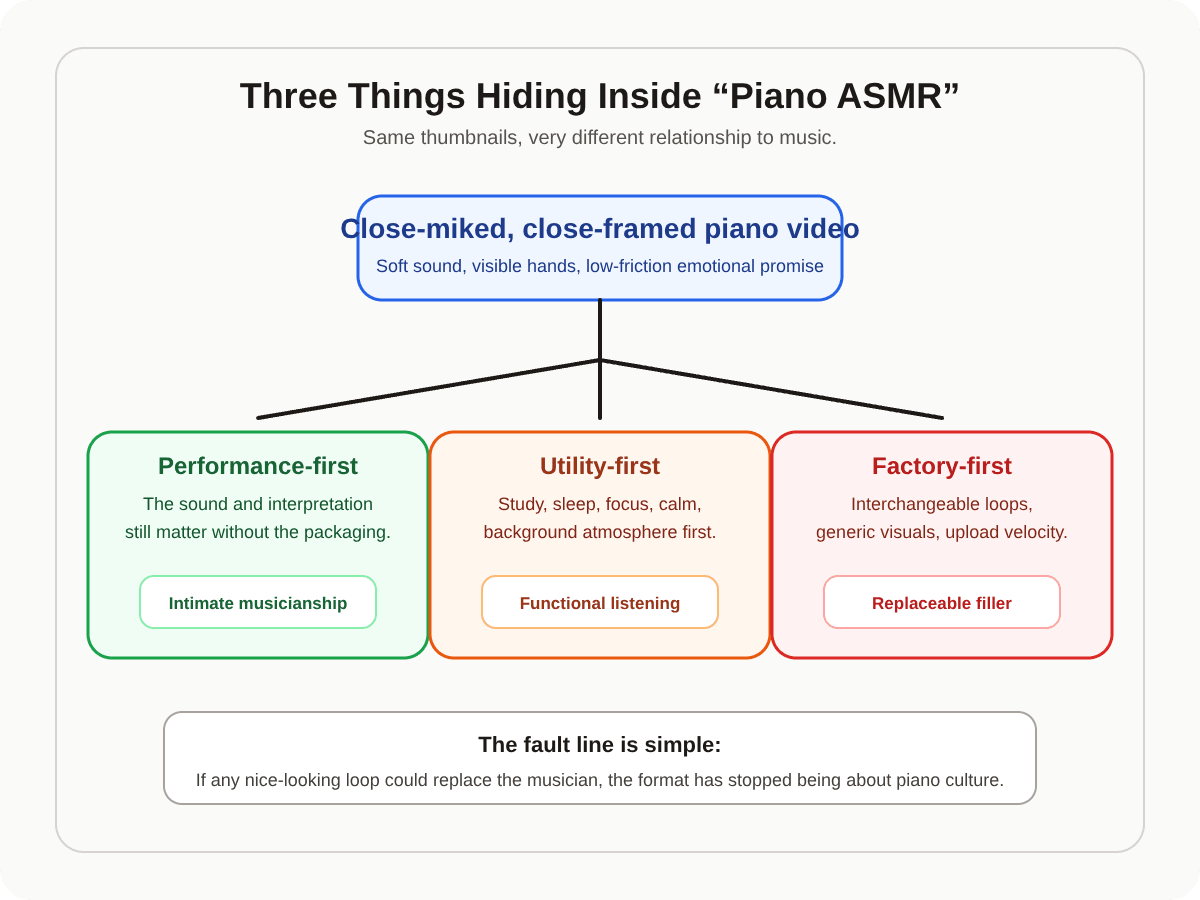
| Type | Main promise | What survives if you strip away the packaging? | Relationship to the pianist |
|---|---|---|---|
| Performance-first piano ASMR | Intimacy and musical detail | The interpretation still matters as music | The listener can become attached to a real player and a real style |
| Utility-first relaxing piano | Focus, sleep, calm, atmosphere | Some music survives, but function usually comes first | The pianist matters less than the mood |
| Factory-first content | Retention, search coverage, upload volume | Very little; any similar loop could replace it | The performer is optional or effectively invisible |
This distinction matters because the cultural argument changes depending on which bucket you are actually discussing. If you are talking about intimate filmed performance, then the format can be a genuinely useful doorway into piano listening. If you are talking about utility videos for sleep and concentration, then the question is not “is this great art?” so much as “is it honestly made and does it still point back to a musician?” If you are talking about factory content, then the issue is not taste. It is replacement.
The best version is still art, even when people use it as background
I do not think musicians should sneer at the entire category. A lot of listeners first encounter piano through low-stakes, non-elite formats. That is not a tragedy. It is often how culture actually spreads. The listener comes for calm, for texture, for atmosphere, for something beautiful that does not make too many demands. If the playing is good, that can still be a real artistic encounter.
Pitchfork’s 2022 feature Inside the Ambient Music Streaming Boom is useful here because it refuses the lazy answer. On one side, it shows how mood playlists can flatten music into what the piece calls an “auditory stress ball.” On the other, it also shows real artists benefiting from wider exposure and some income they genuinely needed. That ambivalence matters. Not every use of music as atmosphere is disrespectful. Brian Eno’s ambient idea was never “you must deep-listen or you are wrong.” It was that music could be both interesting and ignorable.
Where I think the pro-music version still holds up is when the video leaves enough of the musician intact. You can hear this in the difference between mere neatness and actual phrasing. You can see it in touch, timing, voicing, and restraint. That is the same distinction I argued in why playing accurately is not the same as playing musically. Close framing does not erase the difference between expressive playing and correct wallpaper. It just makes the difference quieter.
The format can even strengthen some musical values. It rewards control, listening, tonal discipline, and physical clarity. It can make audiences newly attentive to attack, release, weight, pedaling, and continuity. In that sense it overlaps with what I wrote in how to practice for performance instead of just for the practice room. A camera that close is unforgiving. It turns small musical and technical choices into the whole event.
Where it turns into a content factory
The line breaks when the video stops being about a pianist at all and starts behaving like a supply chain. That shift is not imaginary. It is exactly what has happened in adjacent mood-music scenes. The clearest recent reporting is Pitchfork’s 2025 piece How AI Wreaked Havoc on the Lo-Fi Beat Scene, which describes artists watching their scene get flooded by AI cover art, machine-made beats, and channels uploading endless compilations at industrial speed. The details are lo-fi specific, but the incentive structure is broader than lo-fi.
That is why “piano ASMR” now contains a lot of things that are only piano-shaped. Some are anonymous channels with generic thumbnails and vague titles like “peaceful piano for deep work.” Some are endless rain-and-keys loops with no real artistic identity beyond mood. Some are nominally human but built around throughput rather than interpretation. And some, increasingly, are mixed into the same platform ecology as openly synthetic music. Once the format learns that the performer identity is optional, the race is toward cheaper and more replaceable supply.
My rule for spotting the factory turn
If the same title, same thumbnail style, same rain layer, and roughly the same harmonic wash could be uploaded tomorrow by a totally different anonymous account without anyone noticing, you are no longer looking at a music scene. You are looking at formatted inventory.
Pitchfork’s ambient feature makes the same argument from another angle. It describes the decontextualization problem of playlists that present radically different artists as if they were interchangeable squares of one warm blanket. It also notes YouTube channels like Quiet Quest pulling tens of millions of views on study-and-concentration compilations. Again, the issue is not that ambient or calm music is bad. The issue is what happens when the context is removed so thoroughly that the listener is no longer meeting an artist, only a function.
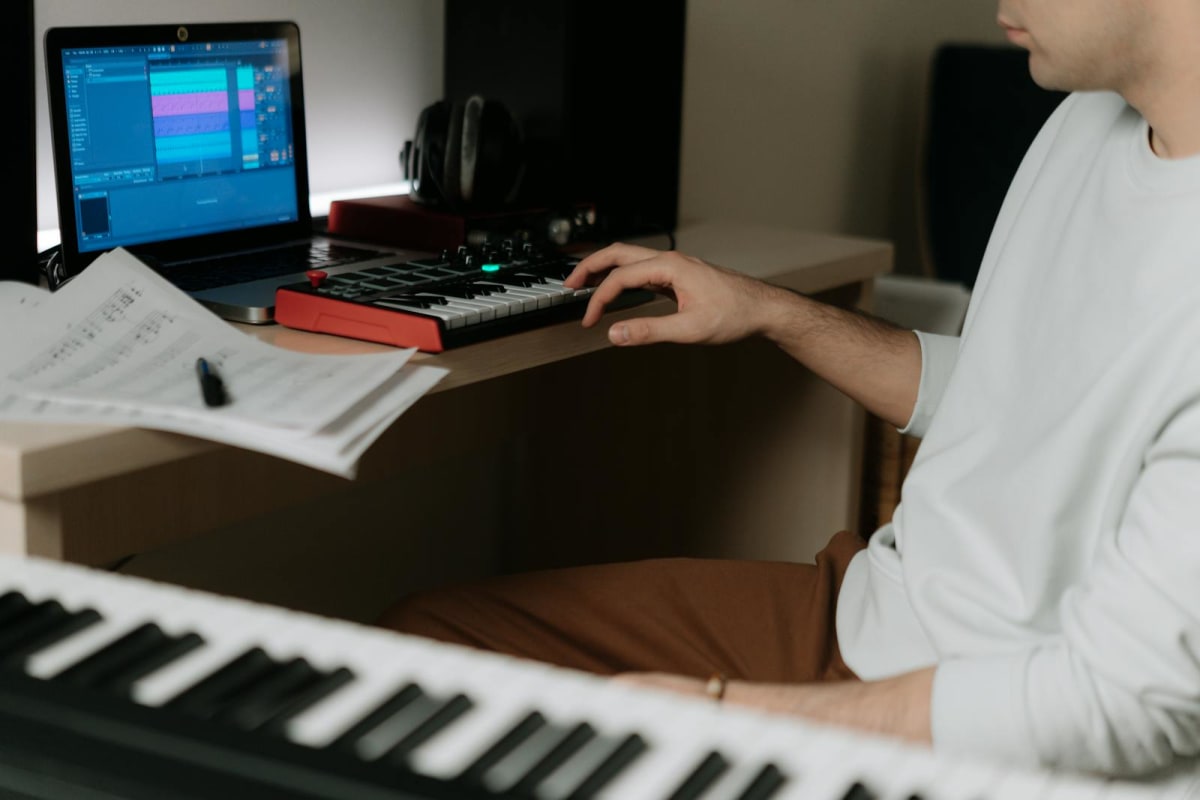
Photo: cottonbro studio via Pexels
This is also why the AI overlap matters, even if a given piano-ASMR video is not fully generated. Once the audience gets trained to accept anonymous pretty calmness as the product, it becomes much easier for semi-synthetic or fully synthetic uploads to compete. That is part of the same broader problem I touched in can AI actually teach you piano: the platform starts rewarding what is easy to package, not what is hardest to understand musically.
What this does to actual piano culture and the people making real recordings
The effect on piano culture is mixed. There is a real upside. Some people who would never click a recital video will click a close, soft, visually satisfying piano upload. Some of them will stay. Some will get curious about repertoire, composers, instruments, pianists, or recording quality. Some will hear voicing and timing more carefully because the format slows them down. That part is genuinely good.
The downside is that the platform keeps teaching listeners to treat piano as a mood service. If the dominant promise is sleep, focus, or calm, then the player can disappear behind the use case. That is exactly the decontextualization worry from the ambient-playlist economy: the audience may receive the sound without building any durable relationship to the person who made it. You can get streams without getting recognition. You can get background attention without getting a real listener.
What the trend gets right
- lowers the intimidation barrier around piano listening
- makes touch, sound, and detail feel immediate
- can reward tasteful recording and controlled playing
- can bring new listeners into instrumental music
What the trend flattens
- encourages music to act like mood wallpaper
- makes pianist identity less important than packaging
- rewards sameness and upload velocity
- creates an easy lane for synthetic or pseudo-anonymous filler
If you want one clean sentence, here it is: piano ASMR is good for piano culture when it still sends the listener toward a musician, and bad for piano culture when it only sends them toward another interchangeable calm rectangle. That is the line I care about. Not whether someone listened while studying. Not whether the room sound was cozy. Not whether rain was added. Those are surface choices. The real question is whether the music remains attached to a person and a set of musical decisions.
Verdict
Piano ASMR is not one thing. At its best, it is intimate filmed musicianship. In the middle, it is honest utility. At its worst, it is just formatted calm content that could have been made by anyone, or no one in particular.
So yes, the rise is real. But the answer to “art or content factory?” is not a shrug. It depends on whether the piano is still the point.
More on science.
AI × Music in 2026: The Living Guide to Suno, Udio, Copyright, and Licensing
AI music in 2026 is moving from open generation toward licensed systems. Here is the current Suno, Udio, copyright, and release-rights picture.
Pract.is Editorial

Why A=440 Hz Is the Standard (and the A=432 Hz Myth)
A=440 became the global standard for practical reasons: coordination, manufacturing, and broadcasting. A=432 is a valid preference, but the bigger healing claims do not hold up cleanly.
Pract.is Editorial

Why Real Instruments Still Matter in an AI Music Era
Real instruments still matter because music is not just output. It is touch, timing, visible effort, feedback from the instrument, and the shared response of people in the room.
Pract.is Editorial