
AI-Generated Songs Are Charting on Billboard. Should Musicians Panic?
AI songs have now reached Billboard charts, but the real story is more specific than the panic headlines suggest. This explainer looks at what actually charted, what still has not, and where the real risk for musicians sits in 2026.
Pract.is
Research-based practice guidance from the Pract.is team.

My answer is no. Musicians should not panic because an AI song hit a Billboard chart.
But I also would not dismiss it. Chart activity matters because charts are not just publicity toys. They are one of the clearest signals the industry uses to decide what audiences will tolerate, what platforms will prioritize, and what investors will fund next.
So the useful question is not “Did a robot beat humans?” The useful question is what actually charted, on which charts, under what conditions, and what that tells us about where this is going.
Important note: this piece was written on March 10, 2026 using current reporting and official documents I could verify, including a Billboard-syndicated report on Xania Monet's Adult R&B Airplay debut, ABC News coverage of Breaking Rust topping Billboard's Country Digital Song Sales chart, Billboard-syndicated reporting that AI acts were charting week after week in late 2025, and the U.S. Copyright Office's AI guidance. For the label-and-licensing side of this story, read the Suno and Udio licensing explainer.
The Panic Meter
| Situation | Should musicians panic? | Why |
|---|---|---|
| An AI act reaches a niche sales chart | No | That is more of a signal than a takeover. It shows chart eligibility and curiosity, not total market replacement. |
| An AI act reaches a radio chart | Not panic, but pay attention | Radio charting suggests real gatekeepers are at least testing the waters. |
| AI tracks start hitting mainstream all-format charts at scale with weak disclosure | Yes, that is a serious problem | At that point the issue becomes discovery distortion, not novelty. |
| Platforms normalize cloned voices and anonymous AI releases | Yes | The biggest threat is identity abuse and catalog flooding, not one viral novelty record. |
What Has Actually Charted So Far
The recent examples matter, but they need context.
The cleanest documented radio example is Xania Monet. In a Billboard-syndicated report published on November 3, 2025, Trevor Anderson reported that Xania Monet's How Was I Supposed to Know? debuted at No. 30 on Adult R&B Airplay, which Billboard described as the first known instance of an AI-based act reaching one of its radio charts.
The clearest digital-sales example is Breaking Rust. ABC News reported on November 12, 2025 that the AI-generated country song Walk My Walk had reached No. 1 on Billboard's Country Digital Song Sales chart. That chart tracks paid downloads, not the full streaming economy, but it still matters because it proved an overtly AI-associated act could sit at the top of a Billboard chart.
Then there is the broader pattern. A separate Billboard-syndicated piece published on November 2, 2025 said that at least one AI-generated or AI-assisted artist had charted in each of the previous four weeks. That is the part musicians should pay attention to. One oddball hit is trivia. A recurring pattern is a market signal.
As of March 10, 2026, the most visible AI-chart breakthroughs are still mostly on sales, radio, genre, or specialist charts, not a clean takeover of the U.S. Hot 100. That distinction matters.
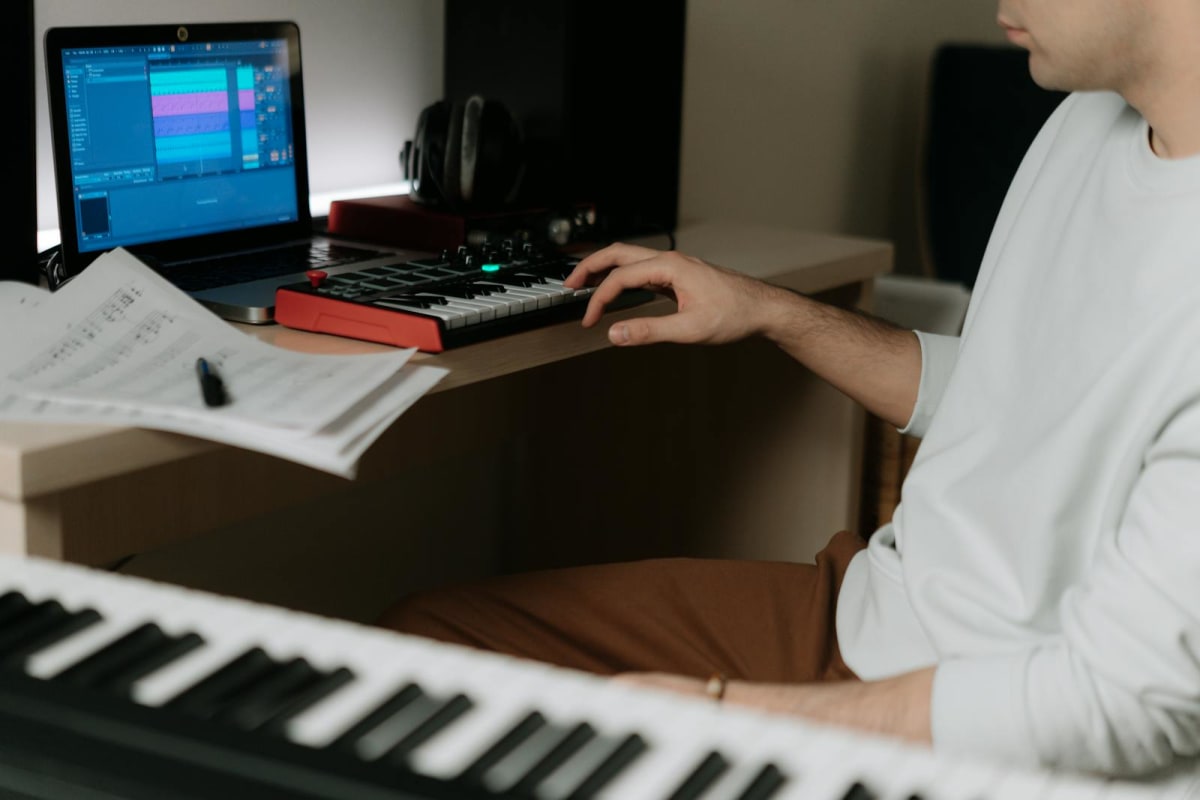
Photo: cottonbro studio via Pexels
Charts measure demand, not merit. They tell you what got consumed, not whether the underlying system is healthy.
Why I Don't Think Musicians Should Panic Yet
First, chart context matters.
A country digital sales chart is not the same thing as the Hot 100. A lower-slot radio breakthrough is not the same thing as mainstream pop domination. If you flatten every chart appearance into “AI has taken over music,” you stop thinking clearly.
Second, novelty still explains some of the attention. A lot of people clicked on these records precisely because they were AI records. That does not mean those listeners are ready to replace human artists as the center of their listening lives.
Third, human music still has structural advantages that AI tracks do not. Real artists perform live. They build long-term audiences. They do interviews, tours, sessions, collaborations, fan communities, and cultural identities that go way beyond one audio file. A chart entry is not the same thing as a durable career.
This is the same mistake people make in other AI conversations too. They confuse a proof of concept with a settled market outcome. I made a similar point in the broader NAMM 2026 AI piece: the existence of a tool does not tell you how much musicians will actually build their lives around it.
Why Musicians Should Still Take This Seriously
The bigger risk is not that one fake artist gets a headline. The bigger risk is that the economics and metadata infrastructure start bending around machine-made volume.
1. Discovery gets diluted fast
If AI music becomes cheap enough to generate at industrial scale, streaming services and short-form platforms get flooded. That makes it harder for real musicians to get discovered, even before you get to questions of taste or artistry.
The problem is not that listeners will suddenly love every AI song. The problem is that platforms reward abundance, speed, and testing. AI is built for exactly that.
2. Disclosure is still messy
This is where the current conversation gets slippery. There is no single, elegant, public-facing standard that makes AI involvement instantly obvious across every platform, every chart, every distributor, and every rights system.
Some songs are clearly marketed as AI. Some are AI-assisted but fronted as human projects. Some are partially synthetic in ways a normal listener would never catch. That makes chart interpretation harder, not easier.
And this is why the phrase “AI songs are charting” needs to be handled carefully. Are we talking about fully synthetic vocals? AI-assisted production? Prompted demos later revised by humans? Voice models? Hybrid songs? Those are not the same thing, commercially or artistically.
3. Identity abuse is the real high-stakes problem
If I had to choose one thing for musicians to worry about first, it would not be a novelty hit on a niche chart. It would be voice cloning, likeness abuse, and catalog-adjacent impersonation.
That is where the commercial incentives get ugly fast. It is also one reason the recent label deals with Suno and Udio matter so much. The business side is moving toward opt-in artist participation and more controlled licensing because everyone can see where the dangerous edge is.
4. Charts can normalize behavior before policy catches up
Once something charts, it stops feeling hypothetical. Investors notice. Platform teams notice. Labels notice. Audiences notice. Even if the chart itself is narrow, the symbolic effect is wider.
That is why I would not wave this away. Charts do not just reflect taste. They help legitimize categories.
What Billboard and the Industry Are Still Figuring Out
From a musician's point of view, three unresolved questions matter most.
| Open question | Why it matters |
|---|---|
| How AI involvement gets labeled | Without clear labeling, charts and platform listings blur together very different kinds of work. |
| What counts as enough human authorship | The U.S. Copyright Office still centers human authorship, which affects ownership and enforcement. |
| How platforms police impersonation and spam | This is where the real damage to working musicians can happen. |
The Copyright Office has already made one thing pretty clear: human authorship still matters. That does not solve every practical platform question, but it does mean the legal system has not simply decided that prompted output deserves the same treatment as clearly human-created work.
So What Should Musicians Actually Watch Next?
I would watch four things.
- whether AI acts move from specialist charts into bigger mainstream chart positions
- whether distributors and streaming services adopt clearer, visible AI labeling
- whether cloned-voice tracks get blocked faster or slip through more often
- whether listeners keep treating AI artists as novelty or start building real loyalty around them
If the first two happen slowly and the third gets controlled, the industry can probably absorb this without full collapse. If the opposite happens, then the panic question gets much less theoretical.
The Bottom Line
AI songs charting on Billboard is not the apocalypse. It is an early warning sign.
What has happened so far shows that AI music is chart-eligible, commercially viable in certain pockets, and no longer easy to dismiss as fringe. What it does not show is that human musicians are suddenly obsolete.
The bigger fight is not “can AI make a catchy song?” It is whether music platforms, chart systems, and rights frameworks can stop synthetic scale from overwhelming human work before the rules are fully built.
That is the part worth taking seriously.
FAQ
Have fully AI-generated songs actually charted on Billboard?
Yes. As of March 10, 2026, the clearest documented examples include Xania Monet reaching Billboard's Adult R&B Airplay chart and Breaking Rust reaching No. 1 on Country Digital Song Sales.
Does this mean AI music is replacing human musicians?
No. It means AI music has crossed from curiosity into measurable commercial activity. That is significant, but it is not the same thing as replacing human careers at scale.
What is the biggest threat to musicians right now?
The biggest short-term risk is not one AI novelty hit. It is platform flooding, weak disclosure, and voice or identity abuse that makes it harder for listeners to tell what they are hearing and harder for human artists to get found.
Should musicians ignore AI chart stories?
No. Ignore the panic language, not the signal. These stories matter because they show where the incentives are moving, and incentives shape the market faster than think pieces do.
More on science.
AI × Music in 2026: The Living Guide to Suno, Udio, Copyright, and Licensing
AI music in 2026 is moving from open generation toward licensed systems. Here is the current Suno, Udio, copyright, and release-rights picture.
Pract.is Editorial

Why A=440 Hz Is the Standard (and the A=432 Hz Myth)
A=440 became the global standard for practical reasons: coordination, manufacturing, and broadcasting. A=432 is a valid preference, but the bigger healing claims do not hold up cleanly.
Pract.is Editorial

Why Real Instruments Still Matter in an AI Music Era
Real instruments still matter because music is not just output. It is touch, timing, visible effort, feedback from the instrument, and the shared response of people in the room.
Pract.is Editorial