
NAMM 2026 Was All About AI. Here's What Musicians Actually Need.
NAMM 2026 made one trend impossible to ignore: AI is now everywhere in music tech. This guide cuts through the hype and argues for the AI tools musicians actually need, from faster feedback loops and stem separation to better practice support and less workflow friction.
Pract.is
Research-based practice guidance from the Pract.is team.

NAMM 2026 had one clear message: every music-tech company now wants an AI story.
Some of that is real progress. Some of it is the usual conference-season inflation, where “AI” gets stapled onto features that are either old, marginal, or not especially useful to working musicians. The interesting question is not whether AI was the dominant marketing language. It clearly was. The better question is: what do musicians actually need from AI?
This is not a booth-by-booth roundup. It is a filter. If you are a serious musician, teacher, or student, the useful lens is not “Which product demo looked futuristic?” It is “Which tools reduce friction, improve feedback, and help me make better musical decisions without adding more clutter?”
Important note: this piece was written on March 7, 2026 using current official product pages and documentation. The examples below focus on products and categories that represent the current AI push in music tech, including ROLI AI Music Coach, Airwave, Moises, BandLab SongStarter, and LANDR AI Mastering.
The Short Version
| AI category | Useful or hype? | Why |
|---|---|---|
| Faster feedback on obvious mistakes | Useful | Good if it shortens the loop between action and correction |
| Stem separation and audio cleanup | Very useful | It saves real practice and production time immediately |
| Prompt-based composition shortcuts | Mixed | Fine for idea generation, weak as a substitute for musicianship |
| AI that claims to replace teachers | Mostly hype | It still cannot match human diagnosis, judgment, and long-term guidance |
| Workflow automation and search | Useful | Musicians benefit when software removes admin and friction |
Why the AI Push Feels So Big Right Now
Because music tech has finally found a story investors, consumers, and marketing teams can all tell at once. AI promises:
- faster learning
- smarter workflow
- better creativity
- less technical friction
- more personalized feedback
Those are powerful promises. But they are also broad enough to hide a lot of weak product thinking. In music, the danger is always the same: tools start optimizing for novelty and engagement instead of actual skill development, better sound, or better decision-making.

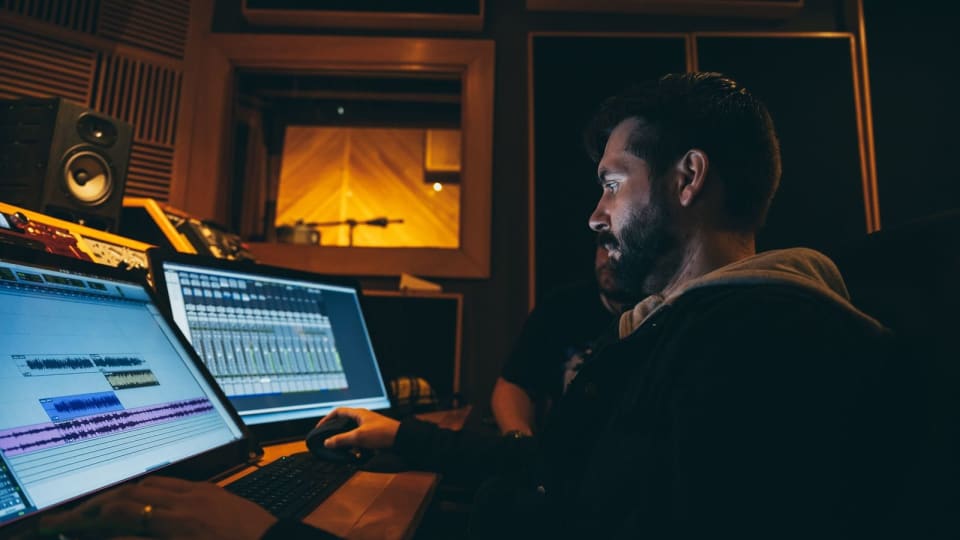
Photo: MART PRODUCTION via Pexels
What Musicians Actually Need From AI
If you strip away the trade-show language, musicians mostly need five things.
1. Shorter feedback loops
This is the strongest real use case. If AI can help a player notice obvious rhythmic drift, repeated wrong notes, or bad practice habits faster, that matters. A tool like ROLI AI Music Coach is interesting precisely because it is trying to move beyond note detection and into more meaningful practice feedback.
But “more meaningful” is not the same as “teacher replacement.” The useful version of AI feedback is: help me catch problems earlier. The hype version is: trust the machine as a full musical authority.
2. Less friction around practice and production chores
Musicians lose huge amounts of time on tasks that are not the art itself:
- isolating parts
- slowing audio down
- cleaning tracks
- transcribing rough ideas
- organizing recordings and references
This is why tools like Moises matter more than many flashier AI demos. Stem separation, key detection, tempo detection, chord identification, and smart practice playback are not glamorous. They are just genuinely useful.
3. Better search, not more noise
One of the most underrated AI opportunities in music is retrieval: help me find the right take, the right section, the right note, the right practice moment, the right recording, the right version. That is much more valuable than yet another generic “creative assistant” floating on top of the workflow.
Musicians already drown in files, fragments, and half-finished ideas. We do not need more content generation nearly as much as we need better navigation of our own material.
4. Tools that respect musicianship
If an AI product trains users to outsource listening, judgment, timing, or taste, it is solving the wrong problem. The right kind of AI should make musicians more independent, not more dependent on prompts and scoring systems.
This is exactly the tension I already wrote about in the ROLI AI Music Coach piece and the piano learning apps piece. Better sensing and smarter software are valuable. But once a product starts pretending to replace pedagogy, interpretation, or judgment, the marketing has outrun the reality.
5. Tools that do not create new subscription bloat
Musicians do not need one more shiny layer that adds complexity, another dashboard, another login, another fragile cloud dependency, and another monthly fee. If AI is going to earn its place, it needs to save more time and effort than it costs.
What Still Feels Like Hype
| Hype pattern | Why musicians should be skeptical |
|---|---|
| “Your AI teacher is all you need” | Music learning still depends on human diagnosis, sequencing, and context |
| Prompt-based creativity as the main value proposition | It can generate starting points, but it rarely solves the deeper craft problem |
| Generic assistants bolted onto old workflows | Many do not remove real friction; they just narrate it with AI branding |
| Automation that hides decision-making | Musicians still need to hear, choose, compare, and revise |
The Useful AI Categories Musicians Should Actually Watch
If I had to bet on what will remain useful after the conference buzz fades, it would be these categories:
Practice support
Not as replacement teaching, but as targeted assistance: timing feedback, habit reminders, repetition tracking, smart logging, and light coaching between lessons.
Audio separation and cleanup
Anything that makes it faster to isolate a line, remove a vocal, slow down a track, or extract material for practice is already worth real money to a lot of musicians.
Administrative compression
Auto-tagging, searchable notes, transcription support, and saner file organization are boring on the surface and enormously useful in real life.
Assistive creation, not substitute creation
Tools like BandLab SongStarter can be helpful if you treat them as sketch triggers, not as the center of your creative identity. That distinction matters.
Draft-level finishing tools
LANDR AI Mastering is useful when you understand what it is: fast draft-level help, not the end of critical listening or engineering judgment.
What I Would Want From AI Music Tech in 2026
If companies really wanted to build for musicians instead of for keynote decks, they would prioritize:
- fewer taps to start practicing
- better review of what happened in a session
- faster access to stems, loops, and isolated sections
- better search across recordings, scores, and notes
- feedback that is humble about its limits
- interoperability instead of closed ecosystems whenever possible
That list is much less glamorous than “your AI co-creator has arrived.” It is also much closer to what musicians actually need.
The Bottom Line
NAMM 2026 was full of AI, but musicians do not need AI everywhere. They need it in the right places.
The strongest AI tools are the ones that reduce friction, save time, and tighten feedback loops without pretending to replace teachers, listening, taste, or discipline. The weakest AI tools are the ones that use futuristic language to avoid solving practical musical problems.
If a tool helps you practice better, search faster, clean up workflow, or hear something more clearly, good. If it mostly gives you a new interface for old confusion, leave it on the show floor.
And if you want the non-hype version of music tech in your own routine, the question is still the same as ever: did this tool actually help you do better work today?
FAQ
Was AI really the main theme at NAMM 2026?
Yes, in the sense that AI is now a dominant framing device across music-tech marketing. The more useful question is not whether the label is everywhere, but whether the underlying feature solves a real musician problem.
What AI tools are actually useful for musicians right now?
The strongest current categories are practice feedback, stem separation, audio cleanup, transcription support, and workflow search or organization. These save real time and reduce friction.
Can AI replace a music teacher or coach?
No. AI can support practice and catch some obvious problems faster, but it still cannot match human diagnosis, repertoire judgment, pain awareness, interpretation, or long-term pedagogical thinking.
What should musicians ignore in the current AI wave?
Be skeptical of products that promise total creative replacement, total pedagogical replacement, or vague intelligence without a clear real-world use case. If the benefit is hard to describe in one practical sentence, it is usually not solving much.
More on science.
AI × Music in 2026: The Living Guide to Suno, Udio, Copyright, and Licensing
AI music in 2026 is moving from open generation toward licensed systems. Here is the current Suno, Udio, copyright, and release-rights picture.
Pract.is Editorial

Why A=440 Hz Is the Standard (and the A=432 Hz Myth)
A=440 became the global standard for practical reasons: coordination, manufacturing, and broadcasting. A=432 is a valid preference, but the bigger healing claims do not hold up cleanly.
Pract.is Editorial

Why Real Instruments Still Matter in an AI Music Era
Real instruments still matter because music is not just output. It is touch, timing, visible effort, feedback from the instrument, and the shared response of people in the room.
Pract.is Editorial