
Music School Management Software in 2026: The Honest Buyer's Map
Compare music school management software in 2026 by pricing model, school type, billing, classes, teaching tools, and the workflows demos hide.
Pract.is Editorial
Research-based practice guidance for musicians from the Pract.is editorial team.

Music school management software is no longer a choice between a spreadsheet and one generic all-in-one. In July 2026, the practical shortlist is My Music Staff for broad low-cost studio operations, Fons/MakeMusic Studio for appointment-and-payment simplicity, Teachworks for usage-based scaling, Opus1 for a growing performing-arts school, and Jackrabbit for class-heavy or multi-location programs. The best product depends less on raw student count than on how your school schedules, bills, enrolls, and teaches. For many schools, the honest answer is one operational platform plus either its native learning tools or a dedicated practice layer after a real pilot.
Start with the job map, not the feature list
Every sales page can show a calendar, an invoice, and a parent portal. Those screenshots tell you almost nothing about whether the software can survive your Tuesday evening: three room changes, a sibling account, a makeup credit, one teacher calling in sick, and a student whose lesson notes need to reach the person actually practicing.
Write down the moments your school must handle before opening another comparison tab. The proof column below is more useful than a checklist of fifty feature names because it turns each promise into something your staff can test.
A solo teacher may need only four of those moments. A multi-location academy may need all six plus permissions, audit history, and data migration. Our music teacher software stack for private studios covers the lighter version of this decision; the buyer map here starts where more teachers, rooms, family accounts, or classes make exceptions routine.
A feature exists when a sales page lists it. A workflow works when a busy teacher can use it correctly without asking the office what to click.
The five serious buyer paths in 2026
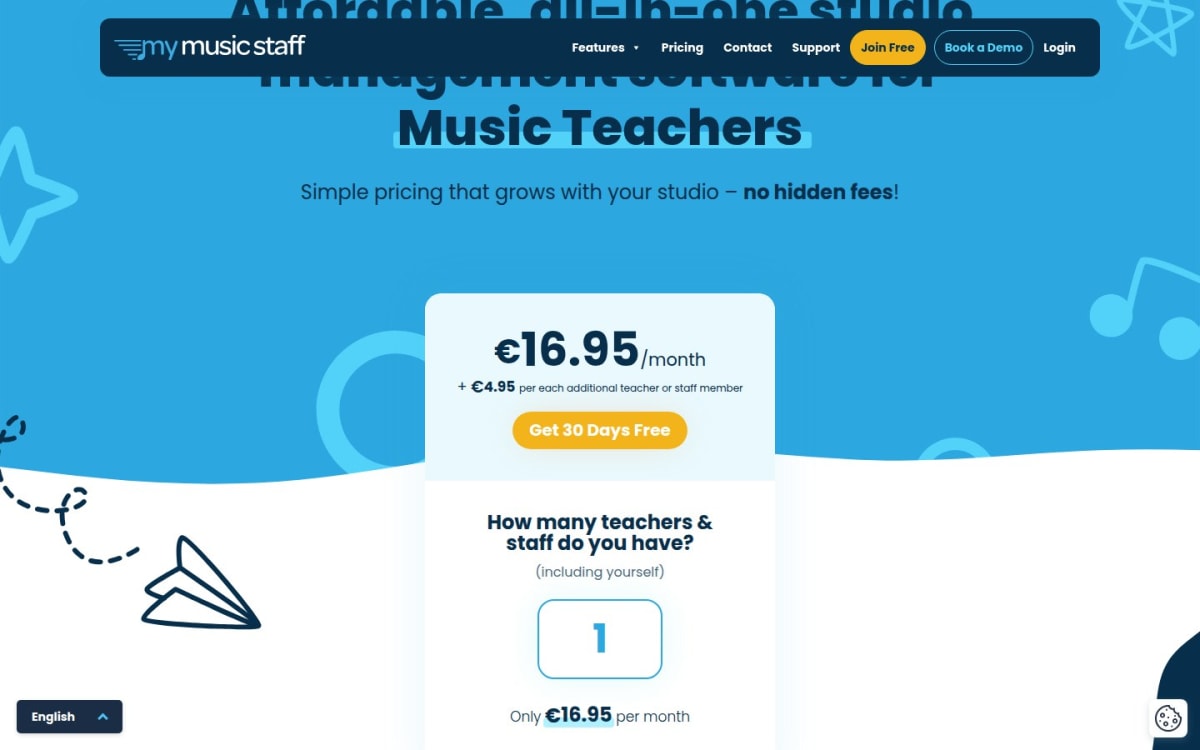
The prices below are public starting points checked on July 18, 2026, not total-cost promises. Payment processing, SMS, optional modules, migration, regional taxes, and staff training can matter more than the headline subscription. My Music Staff also localizes its page: its US-facing listing showed $14.95 while our European capture displayed EUR 16.95.
| Platform | Public price structure | Best fit | Test carefully |
|---|---|---|---|
| My Music Staff | US listing: $14.95/month + $4.95 per additional staff member; unlimited students | Independent teachers and small-to-medium lesson studios wanting one broad system | Role permissions, family billing exceptions, and student adoption of the portal |
| Fons / MakeMusic Studio | $19.95/month + $4.95 per additional staff member; payment fees apply | Appointment-led studios that want scheduling and automatic collection kept simple | Processing cost, class complexity, and the 2026 rebrand communication |
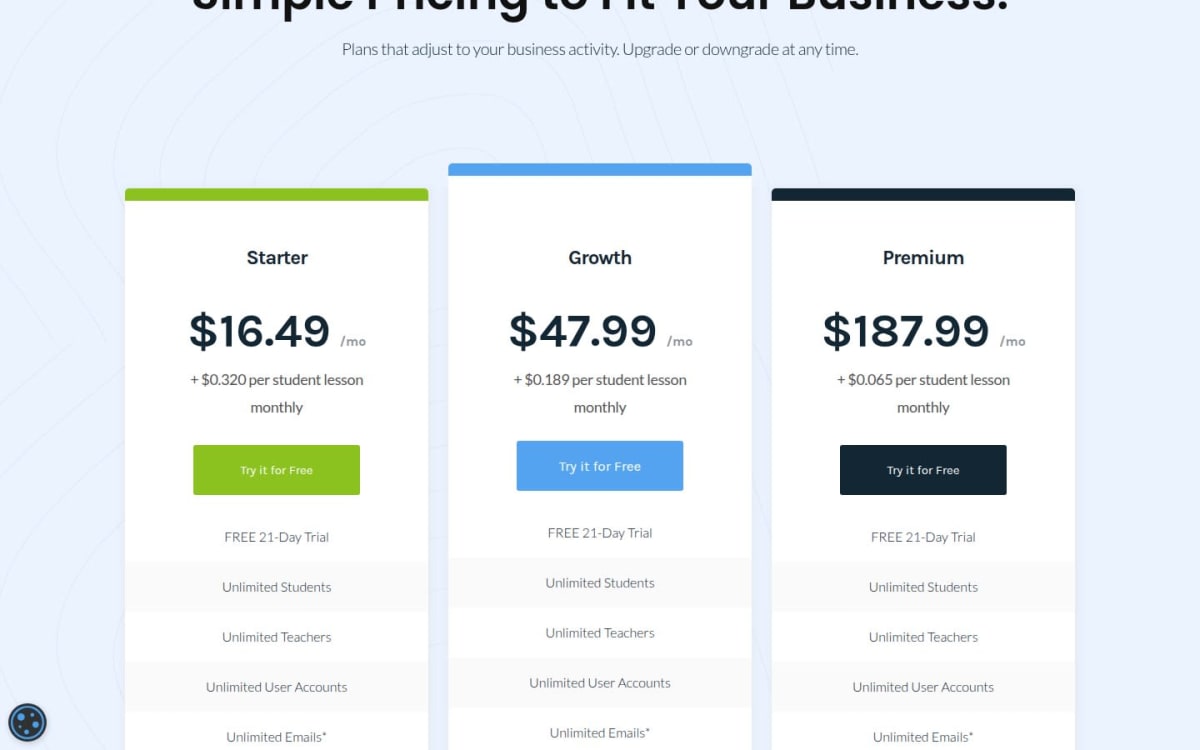
| Teachworks | From $16.49/month + $0.320 per student lesson; higher tiers lower the usage rate | Growing teaching companies needing unlimited users, add-ons, API, or branch options | Your real monthly student-lesson count, especially for groups |
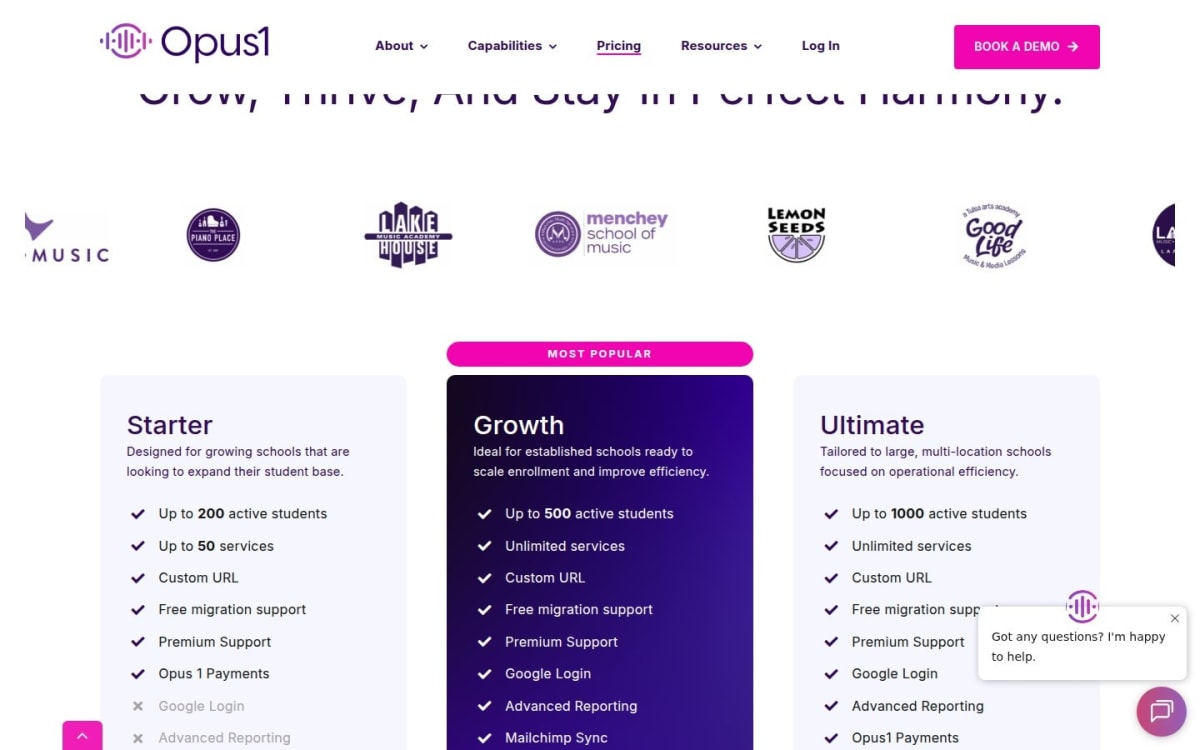
| Opus1 | Packages start at $99/month; detailed plan and add-on pricing requires a demo | Established performing-arts schools needing CRM, trials, classes, recitals, and growth reporting | Quoted total, payment terms, add-ons, and the exact migration scope |
| Jackrabbit Music | From $49/month by student count; Enterprise starts at $245/month | Class-heavy youth programs and multi-location organizations with strong parent workflows | Private-lesson edge cases inside a class-first system |
My Music Staff: the broad low-cost default
My Music Staff now includes far more than scheduling and invoices. The current plan lists attendance, makeup credits, payroll, a website builder, family accounts, lesson notes, assignments, files, integrations, and a student practice log, all under one base plan. Students can use a timer or enter practice manually, attach a note or file, and teachers can view practice history and a summary report. That breadth makes it the sensible first trial for an independent teacher or a lesson-focused school that wants a lot of coverage without a large base fee.
The buying question is not whether it has a practice log; it does. Test whether families will enter through its portal consistently, whether directors can get the school-level view they need, and whether the per-staff model remains favorable as office roles and teachers multiply. Its 30-day trial does not require a credit card, which is enough time to test those behaviors rather than clicking around alone.
Fons is becoming MakeMusic Studio: best for appointment-and-payment simplicity
Fons is strongest when the core business is appointments, cancellation rules, and automatic payments. Its current plan starts at $19.95 per month plus $4.95 for each additional staff member, with separate card, ACH, and subscription-volume fees. It supports online booking, recurring appointments, rooms, payroll reporting, client communication, lesson follow-ups, shared files, and calendar connections.
The product is also changing names. An official rebrand FAQ says Fons is becoming MakeMusic Studio, with existing subscription rates unchanged. Its 2026 catalog and practice app add interactive scores and practice tools for clients, so it should not be dismissed as admin-only. A buyer should still test whether the catalog fits the school's repertoire and whether its appointment model handles every class, ensemble, and family billing rule.
Teachworks: best when activity volume and extensibility matter
Teachworks prices differently from the staff-based tools. Starter currently costs $16.49 per month plus $0.320 for each student lesson; Growth is $47.99 plus $0.189; Premium is $187.99 plus $0.065. All list unlimited students, teachers, and user accounts, while API access begins above Starter and Premium includes the first five branch accounts. A school should calculate all three tiers from a typical month because the lowest base price may not produce the lowest bill.
Its strength is modularity: bulk records, detailed reports, lesson notes, custom forms, many add-ons, and a Repertoire Tracker that stores pieces, statuses, performances, and notes. It suits a growing company that expects unusual reporting or integration needs. The tradeoff is setup surface area; a flexible system can still become a maze if the school enables features without assigning an owner for each workflow.
Opus1: best for an established performing-arts school
Opus1 is the most deliberately school-shaped product in this group. The current plans are organized around growing schools, established schools, and large or multi-location schools, with published capacity bands of up to 200, 500, and 1,000 active students. Across plans it lists private and group scheduling, automated billing, teacher payroll, family messaging, waitlists, trial conversion, reporting, recitals, and free migration support. Its learning-management tools also include goals, materials, progress summaries, lesson history, and staff-visible notes.
That makes Opus1 a real all-in-one candidate rather than merely an office database. It is also a demo-led purchase: packages start at $99 per month, but the public page does not expose every tier and add-on price. Ask for a written quote that includes payments, SMS or voice, CRM/marketing options, locations, migration, and support before comparing it with a lower headline fee.
Jackrabbit Music: best for class-heavy and multi-location programs
Jackrabbit Music comes from a broader class-management platform used across youth activities. That background is an advantage for schools with online registration, recurring group classes, parent accounts, attendance, makeup policies, staff portals, skills/levels, and several locations. Private lessons are supported through an activity calendar that considers teacher and room availability, while the Enterprise product adds multi-location access and business-intelligence views.
Core plans currently start at $49 per month and scale by student count; Enterprise starts at $245. The sensible caution is fit, not capability. A school built mainly around weekly one-to-one lessons should test rescheduling, teacher substitutions, sibling billing, and room assignment before choosing a platform whose deepest history is in class-based youth programs.
The practice question deserves its own test
The old version of this guide drew too sharp a line between management systems and teaching systems. That line moved. My Music Staff has a timer and practice log; Fons has lesson follow-ups plus a new music catalog and practice app; Teachworks has shared lesson notes and repertoire tracking; Opus1 has learning management; Jackrabbit has lesson plans and skill progression.
Those features are real. They are not interchangeable. One records minutes and uploads, another organizes interactive scores, another tracks repertoire states, and another measures class skills. The practical test is whether a student can capture useful evidence quickly and whether the right teacher can see a week's pattern before the next lesson.
Practis is our product, and this is where it fits honestly. It does not replace invoicing, payroll, enrollment, or room scheduling. It adds a dedicated student practice diary, assignments, recordings, repertoire progress, weekly patterns, lesson prep, and recap continuity. A private teacher or small studio can evaluate that layer at Practis for teachers; a school that needs multiple teachers, program oversight, custom onboarding, and institutional reporting should use the music schools and institutions route.
Do not add a second system merely because it has a nicer dashboard. First run the native learning tools with real students. Add a dedicated layer only if it produces better student adoption, faster lesson preparation, or a school-level signal the management platform cannot give you. Our student practice log buyer's guide for music schools gives that pilot a narrower set of criteria.

Operating model beats headcount
Two schools with 120 students can need different software. One may run fixed private lessons with simple monthly tuition; the other may run group classes, rolling enrollment, trial funnels, several rooms, and a recital every six weeks. Headcount affects price. Operating model determines fit.
The buyer's transit map
The map also explains when not to upgrade. A forty-student school with fixed recurring lessons may run comfortably on My Music Staff or Fons. A sixty-student school with camps, group enrollment, rotating rooms, trials, and contractor payroll may already need Teachworks or Opus1. Jackrabbit becomes more compelling when class registration and parent self-service dominate the week.
Larger schools and conservatory-style programs should widen the evaluation beyond commercial studio admin. Our software guide for conservatories and serious music programs covers faculty workflows, reporting, institutional access, and program-level needs that a normal studio comparison misses.
Student count changes the invoice. Exceptions change the product you need.
A 30-day pilot should try to break the system
A polished demo follows the vendor's happiest path. Your pilot should do the opposite. Use a small live cohort: one administrator, two teachers with different habits, ten families, one group class, and enough awkward cases to expose where manual work returns.
Score each task from zero to two: zero means the vendor had to rescue you, one means a workaround, and two means an ordinary staff member completed it without help. Weight the recurring tasks twice. A rare annual export should not outweigh a weekly rescheduling workflow that consumes the office every day.
Also measure adoption rather than intention. How many teachers completed notes? How many students opened assignments? How many families used self-service correctly? If the reports still have to be rebuilt manually, our post on tracking music student progress without spreadsheets shows why a cleaner data model matters more than a prettier dashboard.
Price the whole stack before signing
The subscription fee is only the first line. Calculate the twelve-month cost of software, payment processing, SMS or voice, optional modules, migration, setup, staff training, a temporary overlap with the old system, and any separate teaching or practice layer. Then put a value beside the weekly admin the new system genuinely removes. Cheap software that adds three hours of reconciliation is not cheap.
Before signing, get written answers to practical ownership questions: Can you export families, attendance, invoices, lesson notes, and repertoire in usable formats? Which roles can see financial, child, and teaching data? What happens to stored payment methods during migration? Where is data hosted, how is it backed up, and what agreement is available for your jurisdiction? What support is included after onboarding? Which quoted features are add-ons or still on a roadmap?
The shortest honest recommendation is this: start with My Music Staff if you want the broadest low-cost default; compare Fons/MakeMusic Studio when appointments and automatic payments are the center of the business; model Teachworks when lesson volume, branches, and API access matter; put Opus1 on the shortlist for an established performing-arts school; and trial Jackrabbit when classes, parent registration, and multiple sites dominate. Test the native learning layer before adding another tool, then add Practis only when the evidence between lessons is still the missing part.
The winner is not the platform with the longest feature page. It is the one your office, teachers, families, and students can all use on the same difficult week.
More on teaching.

Tonara Alternatives for Teachers and Studios After the Shutdown
Tonara alternatives for teachers and studios, compared by assignments, practice logs, recordings, messaging, admin tools, pricing, and migration friction.
Pract.is Editorial

What to Charge for Piano Lessons in 2026 (Data + a Calculator Mindset)
Set sustainable piano lesson rates for 2026 using current benchmarks, real workload, collected hours, payment fees, and a practical rate-floor formula.
Pract.is Editorial
How to Start Teaching Piano Online in 2026 (From First Student to Full Studio)
Start teaching piano online with a clear offer, first-student plan, studio policy, lesson workflow, and growth system that stays manageable.
Pract.is Editorial