
Best Software for Conservatories and Serious Music Programs
Conservatories, pre-college programs, and serious music academies need software that scales beyond basic studio management - real progress evidence, repertoire planning, assessment data, and program-level oversight without infantilising advanced students.
Pract.is Editorial
Research-based practice guidance for musicians from the Pract.is editorial team.

Most music school management software was not built for conservatories. MyMusicStaff, Teachworks, Studio Helper - the tools that dominate the private studio and music academy market - assume a billing-and-scheduling shape that does not match what a conservatory, pre-college program, or serious music academy actually needs. The mismatch is not at the operational layer; conservatories need scheduling and billing like anyone else. The mismatch is everywhere else: at the depth of repertoire tracking, the way assessment evidence is collected, how applied faculty supervise student preparation, and how program leadership sees what is actually happening across departments.
This article is for conservatory and serious-program leadership - directors, deans, department chairs, applied faculty heads - evaluating institutional software in 2026. It covers what conservatory-grade tools have to do that ordinary studio software does not, where the standard platforms stop, and how Practis fits as the practice-and-progress layer designed specifically for serious music education. The Pract.is article on conservatory studio practice tracking for applied faculty covers the applied-faculty single-studio case in depth; this article is the institutional view above it.
Three things conservatory software has to do that ordinary studio software does not
Why standard studio platforms underserve conservatories
Most music school management platforms were built for the K-12 or private-studio context. Their core jobs - family billing, scheduling siblings into recurring slots, parent communication, attendance tracking - are designed around the family-as-customer model. A conservatory does not work that way. The student is an adult, the institution bills the student or their financial aid office rather than a parent, the scheduling problem is room and ensemble allocation more than lesson booking, and the practice life is structurally different from any private-studio model the platforms were optimised for.
The honest mismatch shows up in three specific places. First, repertoire and progress tracking: conservatory students carry three to five pieces in motion at any time across a fourteen-week semester, with juries and recitals on fixed dates. Standard platforms have no concept of this architecture; their practice modules treat each session in isolation. Second, assessment evidence: conservatory assessment is built around juries, recitals, performance review, and end-of-term evaluations - not around the attendance percentages and tuition-tracking that studio platforms produce. Third, program-level oversight: the dean or department chair needs to see patterns across many applied studios, which is operationally different from the studio-owner-with-one-roster view that studio platforms were built for.
This is not a flaw of the studio platforms. They were built for a different market. The Pract.is article on best music school management software in 2026 covers the studio platforms in depth; for conservatory leadership, the takeaway is that the studio platforms cover the billing and scheduling layers fine but leave the teaching and assessment layers thin.
"Standard music school platforms cover billing and scheduling fine. The teaching, assessment, and program-oversight layers - where conservatory leadership actually needs visibility - they leave thin or empty."
The three institutional levels
A conservatory or serious music program operates at three levels at once. Software that works at this scale has to serve all three views without forcing the levels to share one dashboard. The diagram below shows the hierarchy and what each level needs from the practice-and-progress layer.
Three institutional levels, three views
The diagram makes the central institutional argument visually: conservatory software is not one dashboard. It is three views built on the same underlying data. The applied faculty sees their studio's preparation in detail. The department chair sees aggregated patterns across faculty. The dean sees institutional signals. Studio management platforms were not built with this hierarchy in mind, which is why they end up running at the bottom level alone and producing program-level data that has to be reconstructed in spreadsheets.
The seven institutional jobs
A conservatory-grade software stack has to handle seven specific jobs. Each one is honest and observable; together they define what serious institutional software has to do.
Student progress tracking records what each student is preparing, where each piece is in its development, and how their playing is evolving across the term. This is not minute counts. It is repertoire state, recording evidence, and the student's own reflection across weeks.
Teacher visibility gives applied faculty a real view of the week between lessons - sessions, focus areas, recordings, reflections - so the lesson hour starts at the student's current point instead of at a status update.
Repertoire planning tracks the multiple pieces each student carries and when each one converges on a milestone (jury, recital, concerto competition, audition). The Pract.is article on best apps to track piano repertoire covers the underlying repertoire-state taxonomy.
Practice expectations capture what the institution communicates to students about how to work. This includes assigned focus areas, weekly targets, and the assessment criteria the student is being prepared against.
Assessment evidence is the layer that supports juries, recitals, performance reviews, and end-of-term evaluations. This is closer to formative assessment than to numeric grading - the evidence is what the student did across the term, not just what they played in the final performance. The Pract.is article on formative assessment in music class with practice data covers the underlying framework.
Communication handles teacher-to-student notes inside the practice context, department-level announcements, and the kinds of cross-faculty conversations that institutional music education requires.
Program-level oversight aggregates patterns across departments for leadership: which areas are losing students, which jury cohorts are unprepared, where intervention is needed. This is the layer studio platforms do not produce, and the layer conservatory leadership needs most.
What the major platforms actually do
The conservatory software market is fragmented. There is no single dominant platform that does all seven jobs. The honest picks are different in each category.
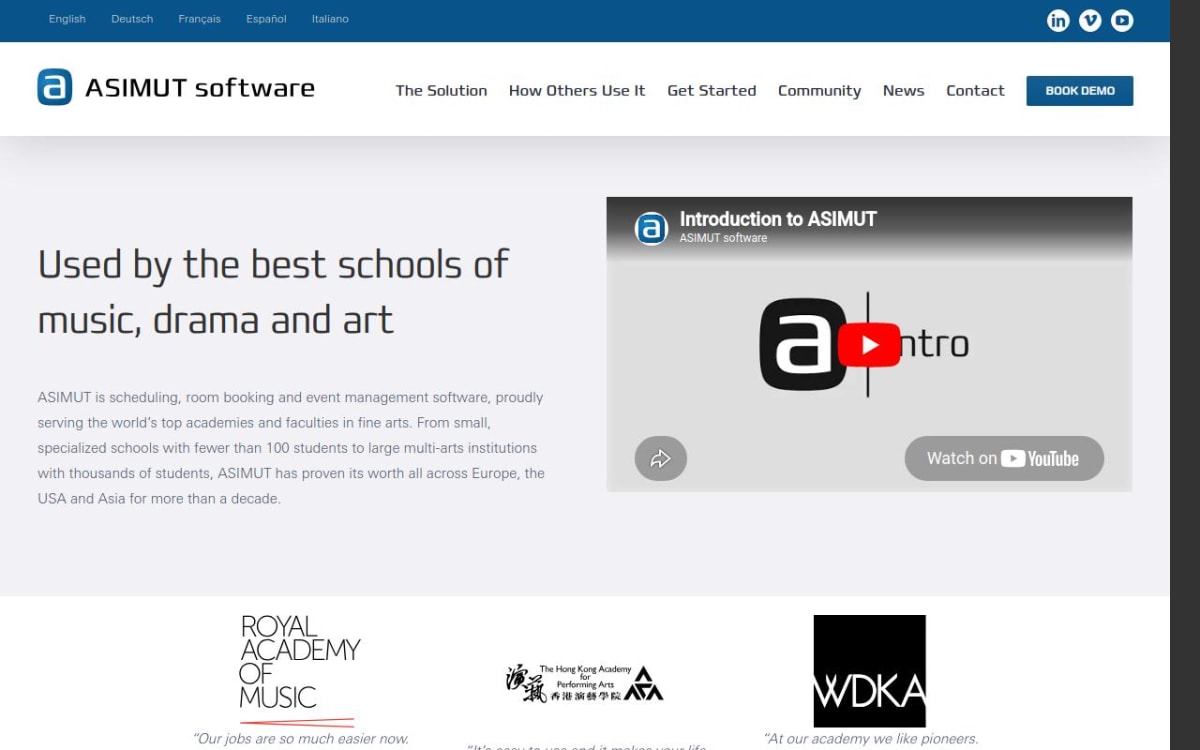
ASIMUT is the most widely adopted institutional platform at conservatories and music universities worldwide, used by institutions including Juilliard, Royal College of Music, and Berklee. Its core strength is scheduling and space management at scale: classroom and practice-room allocation, ensemble scheduling, faculty assignment, and the kind of complex calendaring that a multi-department institution needs. It also handles student records, course enrolment, and reporting for the registrar's office. Where it stops: practice tracking, repertoire state, and the teaching-layer evidence are not its strengths. ASIMUT is the operational backbone many conservatories run on, with the teaching layer added separately.
Music-specific LMS platforms - MusicFirst, SmartMusic, Auralia, Sibelius's institutional offerings - sit at the curriculum and assessment layer. They are strongest where conservatory teaching uses standardised method books, sight-reading exercises, ear training drills, and theory work. Where they stop: the applied studio's real practice life is not catalogue-based. A Liszt etude or a Brahms chamber piece is not in the LMS, and the student's preparation is what the institution actually cares about.
Generic learning management systems - Canvas, Blackboard, Moodle - are adopted at the university-affiliated conservatories because the parent institution mandates them. They handle course enrolment, syllabus distribution, and grade submission well. They are not built for music; applied faculty almost universally find them an awkward fit for studio teaching and use them only for the administrative work the institution requires.
Where Practis sits in a conservatory stack
Practis is the practice-and-progress layer for serious music programs - the layer that ASIMUT, the LMS, and the studio platforms leave thin. Applied faculty get a clean studio dashboard with real practice evidence, repertoire state, and pre-lesson context for each student. Department chairs get cross-studio aggregation: which faculty's roster is drifting, which jury candidates are under-prepared, where repertoire coordination is needed. Program leadership gets the institutional patterns rolled up: retention signals, jury and recital readiness, preparation gaps that need intervention.
The pitch is not that Practis replaces ASIMUT or the LMS. It sits beside them and fills the institutional column they leave empty. The student's practice life lives in Practis; the room scheduling and registrar's records stay in ASIMUT; the curriculum content stays in whatever LMS the institution has standardised on. The three systems coexist, and the institution finally has the teaching-evidence layer that none of them was built to produce.
Crucially, Practis at the conservatory level does not introduce K-12 gamification mechanics. Streaks, badges, and points - the features that work for ensemble band students - are inappropriate for advanced students preparing for professional careers, and Practis is designed accordingly. The Pract.is article on conservatory studio practice tracking for applied faculty covers the applied-faculty side in detail; for institutional leadership, the same design principle holds at scale: oversight without infantilising the students you are trying to develop into professional artists.
A working conservatory stack
The table below shows a working software stack for three different sizes of serious music program. The picks are representative; specific platforms vary by region and institutional history.
A working stack by institutional size
| Layer | Pre-college academy | Mid-sized conservatory | Major conservatory |
|---|---|---|---|
| Scheduling & space | MyMusicStaff or Teachworks | ASIMUT | ASIMUT |
| Student records | Inside management platform | ASIMUT or SIS integration | SIS (Banner, PeopleSoft) + ASIMUT |
| Course / curriculum | Light - inside platform | Music-specific LMS (MusicFirst) | University LMS (Canvas) + music LMS |
| Practice and progress | Practis | Practis | Practis |
| Repertoire planning | Inside Practis | Inside Practis | Inside Practis |
| Assessment evidence | Practis + recital records | Practis + ASIMUT records | Practis + SIS + ASIMUT |
| Program oversight | Practis director view | Practis department + program views | Practis with custom institutional dashboards |
The pattern is consistent across the three sizes: the operational layer scales up (small platform to ASIMUT to ASIMUT+SIS), but the practice-and-progress layer stays constant. That is not a coincidence. The practice-and-progress job does not change at scale the way operational complexity does. What changes is how many faculty and students are connected to the same teaching-evidence system - which is exactly what an institutional dashboard is built to surface.
Common mistakes conservatory leadership makes
A few specific patterns recur and are worth flagging.
The first is trying to extend ASIMUT or the LMS into the practice-tracking job. Both platforms were built for operational and administrative work; their attempts at practice modules are minimal. Conservatories that try to use them for practice oversight end up with sparse data that does not support the teaching decisions leadership needs to make.
The second is importing K-12 gamification into the conservatory studio. Streaks, badges, and points produce the wrong relationship with advanced students. Tools designed for ensemble band programmes are not the right fit for an applied conservatory studio, no matter how compelling the marketing.
The third is treating practice oversight as compliance. The conservatory student is an adult. Tools and policies that feel surveillance-shaped backfire by month two. The Pract.is article on conservatory studio practice tracking for applied faculty covers this distinction - oversight is for the teacher's planning, not the student's compliance.
The fourth is not piloting at the applied-studio level first. Institutional rollouts that start with a top-down mandate produce passive resistance from faculty. The realistic approach is to pilot with two or three applied faculty for one semester, refine the workflow with their input, then scale to the department and program.
The fifth is letting different departments adopt different practice tools. If string area uses one tool and woodwinds another, the program-level view collapses into a spreadsheet exercise. Institutional consistency matters here more than at any other layer of the stack.
What changes when the institutional stack is right
Conservatories and serious programs that run a real three-level practice-and-progress layer across a year report several specific changes. Applied faculty arrive at studio lessons with context. Department chairs catch faculty-level drift in week 4 rather than week 10. Jury and recital preparation becomes visible before the final week. Retention signals appear earlier, when intervention is still meaningful. Program-level reporting becomes possible without faculty manually compiling spreadsheets at the end of every term.
The deeper change is that the institution stops relying on memory and impression to manage what is happening across many studios. The dean can answer "how is preparation going for spring juries?" with evidence instead of intuition. The department chair can have a faculty conversation grounded in data rather than in feel. The applied teacher can do what they were trained to do - teach individual artistry - while knowing the institution sees their work and supports it.
Conservatory software is not one platform doing everything. It is three institutional levels honoured by the same underlying teaching record. Pick the stack that gets that right, and the rest of the institution's job becomes meaningfully easier.
More on teaching.
Tonara Alternatives for Teachers and Studios After the Shutdown
Tonara alternatives for teachers and studios, compared by assignments, practice logs, recordings, messaging, admin tools, pricing, and migration friction.
Pract.is Editorial

What to Charge for Piano Lessons in 2026 (Data + a Calculator Mindset)
Set sustainable piano lesson rates for 2026 using current benchmarks, real workload, collected hours, payment fees, and a practical rate-floor formula.
Pract.is Editorial
How to Start Teaching Piano Online in 2026 (From First Student to Full Studio)
Start teaching piano online with a clear offer, first-student plan, studio policy, lesson workflow, and growth system that stays manageable.
Pract.is Editorial